Book 04 · The discovery problem

Discovering Compositional Worlds from Interaction

294 pagesFirst Web EditionSeptember 7, 2026
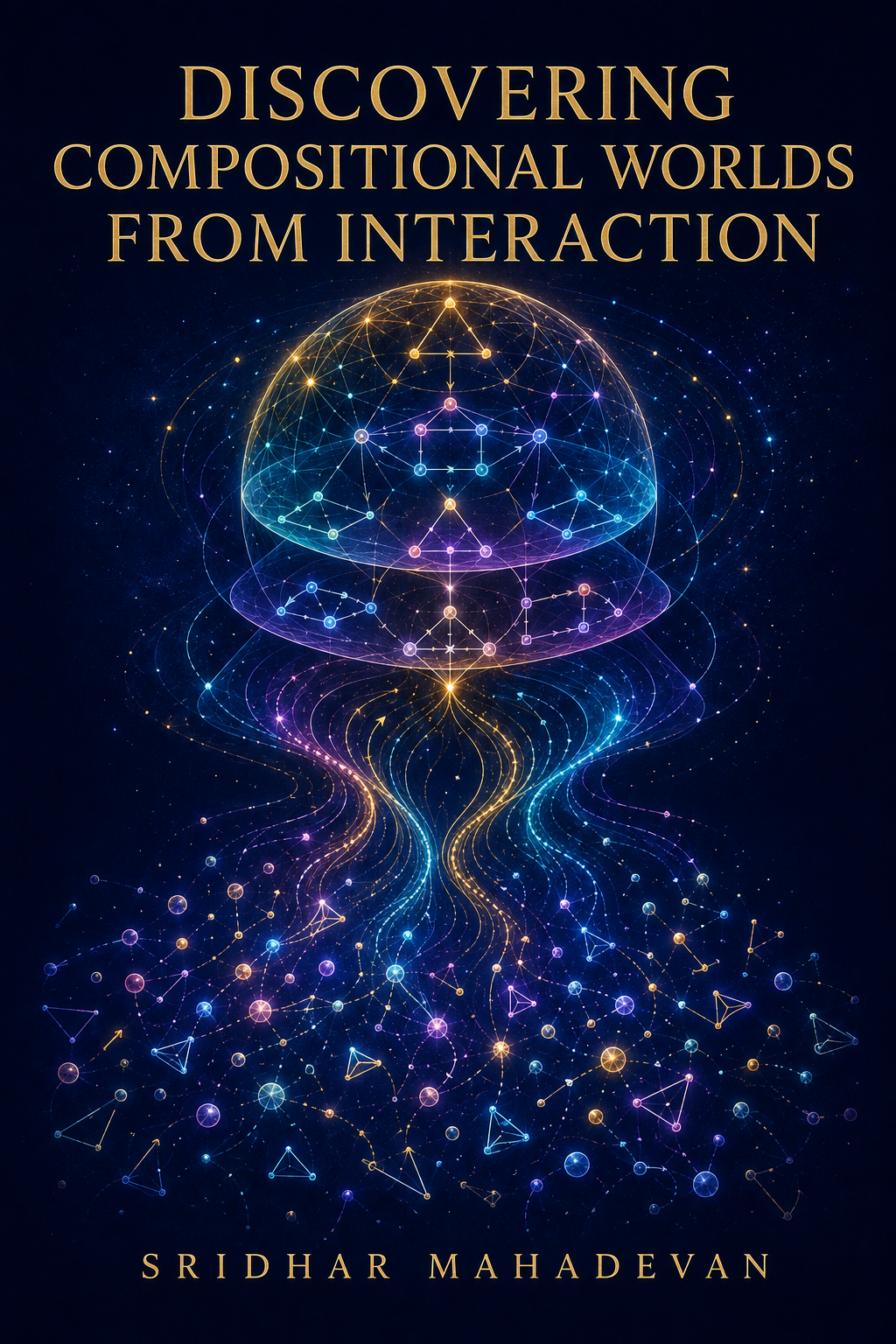
Cover of Discovering Compositional Worlds from Interaction by Sridhar Mahadevan

Scope

A categorical theory of how lifelong learners discover compositional worlds, their generating presentations, and the doctrines that govern what can be learned.

Start here

Begin with Chapter 0 for the Piagetian and core-knowledge motivation, then follow the ORACLE program into UOCL, UODL, coherent repair, and persistent structure.

Chapter outline

Part I

Foundations of Categorical Identification

p. 23
  1. The Infant's Problemp. 25
  2. A Categorical and Homotopical Toolkitp. 39
  3. The ORACLE Programp. 65
  4. Categorical Identification Under a Priorp. 77
Part II

Categorical Core Knowledge

p. 87
  1. Core Knowledge and Piagetian Constructionp. 89
Part III

Universal Online Categorical Learning

p. 107
  1. Learning Inside Fixed Doctrinesp. 109
  2. The UOCL Machinep. 139
  3. Persistent Categorical Identificationp. 151
  4. Probably Approximately Categorically Correct Learningp. 159
Part IV

Universal Online Decision Learning

p. 169
  1. Online and Persistent Universal Decision Learningp. 171
Part V

Global-Clock Online Decision Learning

p. 199
  1. Convex and Regularized Universal Actionp. 201
  2. Universal Bandit Decision Learningp. 211
Part VI

Information Beyond a Global Clock

p. 217
  1. Information Categories and Decentralized Decisionsp. 219
  2. Agentic Safety and Universal Online Decision Learningp. 227
Part VII

Coherent Repair and Structural Amplification

p. 235
  1. Homotopy and Tangent Repairp. 237
  2. Invariance, Amplification, and Approachabilityp. 245
Part VIII

Persistent Structure Across a Lifetime

p. 253
  1. Persistent Structure Across a Lifetimep. 255
  2. Synthesis and the Next ORACLE Theorem Ladderp. 263

How to read the claims

ORACLE is a theoretical research program. Its categorical identification, PACC, evolvability, safety, and stabilization results state explicit assumptions and leave a theorem ladder of open problems; they are not claims of a finished AGI system.

Selected supporting record

Papers, software, and evidence packets

This is a claim-scoped selection, not a complete bibliography. Local experiment packets are described but not publicly attached.

paper

Language Identification in the Limit

Classical identification-in-the-limit paradigm generalized by ORACLE from languages to categorical worlds and doctrines.

Ch. 2 · Ch. 3 · Ch. 6

paper

Précis of What Babies Know

Empirical and theoretical motivation for treating core knowledge as a structured prior over compositional worlds.

Ch. 0 · Ch. 4

paper

Evolvability

Source paradigm for the PACC evolvability construction based on local mutations evaluated through statistical performance.

Ch. 8

Open the curated evidence library

Experiment-to-code map

From chapter summaries to executable records

Each family records its chapter destination, code package, executable entry points, result artifacts, and evidentiary boundary.

Open the complete experiment atlas

Code companions

Public repositories and release gaps

Public links open the inspectable GitHub package. A local-only package is shown explicitly so an unpublished research archive is never mistaken for a reproducible public release.

← Return to the four-book sequenceTrace experiments to code →