ora-0003
Trail Map
The problem of discovering compositional worlds from interaction is formulated through categorical and tangent identification, online decision learning, coherent repair, structural amplification, safety, and lifelong transport. Chapter 0 supplies the developmental and empirical motivation, and Chapter 1 supplies the language. Chapters 2–3 define ORACLE, presentation protocols, categorical identification in the limit, the Grothendieck hypothesis fibration, fragmentwise observability and gluing, and the boundary between assimilation and accommodation. Part II asks whether the Spelke–Piaget proposal has non-vacuous categorical content. Part III turns the ORACLE semantics into UOCL by first locating established learning paradigms inside the framework, then developing selection, probing, repair, learning of generators and relations, persistent identification, discovery of tangent structure, and the optional search for a differential presentation that realizes that geometry. It then relaxes exact identification to PACC learning through statistically covered categorical probes. Part IV introduces UODL as the independent specialization obtained by adding information, action, consistency, and observation maps.
Part V studies global-clock realizations, moving from online convex optimization to restricted bandit feedback. Part VI leaves the centralized clock behind for decentralized, asynchronous, and endogenous information and for the safety of agentic teams. Parts VII–VIII develop repair, structural amplification, and lifelong transport.
Particle physics provides a cross-part scientific thread. The same collider declaration appears first as a restricted Yoneda-style identification problem, then as active UOCL, PACC approximation, localized theory repair, and finally transport and persistence across experimental contexts. Its role is to keep presentation, response semantics, observational equivalence, and ontological claims visibly distinct.
From identifying a world to preserving useful structure across a lifetime.
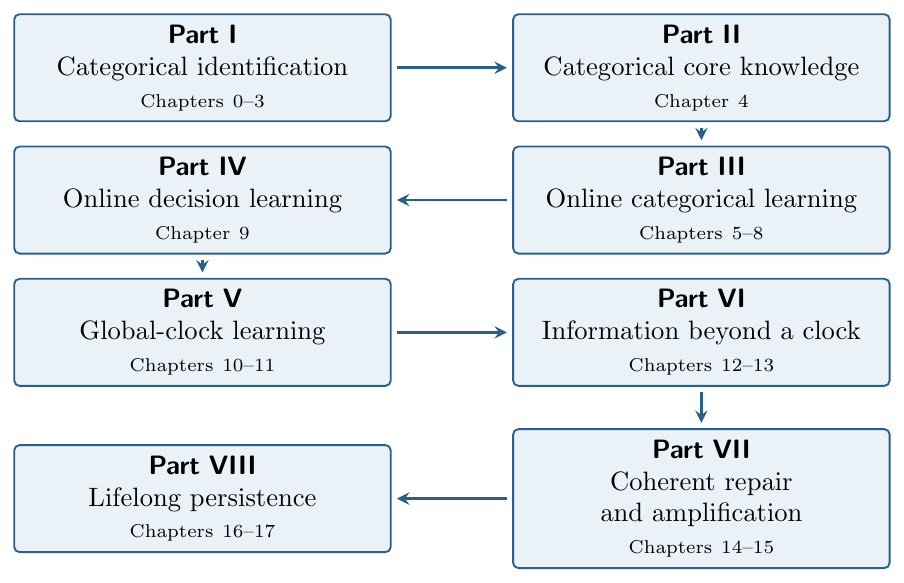
The ORACLE architecture. A result is marked as a research target when its exact mathematical obligation is stated without a completed proof.
|
Chapter |
Theme |
Central question |
Present status |
|---|---|---|---|
|
0 |
Developmental grounding |
How do core knowledge and Piagetian repair motivate ORACLE? |
Empirical foundation |
|
1 |
Categorical and homotopical toolkit |
What language supports categorical identification and decision? |
Tutorial foundation |
|
2 |
The ORACLE program |
What does a learner know before it discovers its categorical world? |
Program and semantics |
|
3 |
Identification under a categorical prior |
When do Gold-style presentations converge, when do fragmentwise probes glue, and when must the doctrine change? |
Definitions and local-to-global theorem |
|
4 |
Categorical core knowledge |
What would make the Spelke–Piaget proposal categorically non-vacuous? |
Comparative criteria and developmental theory |
|
5 |
Established paradigms as UOCL |
Which categorical priors and query quotients are assumed by familiar learners? |
Comparative specialization theory |
|
6–8 |
UOCL algorithms and approximation |
How are categorical and tangent hypotheses selected, probed, repaired, and stabilized; when can a differential realization be identified; and when is approximate identification statistically reliable? |
Foundational theory |
|
9 |
UODL specialization |
When does a learned category support persistent online decision? |
Foundational theory |
|
10–11 |
Global-clock realizations |
How do OCO, regularized action, and bandits instantiate UODL? |
Exact finite theory |
|
12–13 |
Information beyond a clock |
What survives decentralized, asynchronous, or endogenous information? |
Theorems and research targets |
|
14–15 |
Coherent repair and amplification |
When do defects admit repair, and when do weak structures compose into stronger ones? |
Theorems and research targets |
|
16 |
Lifelong persistence |
Which learned constructions survive changes of task and environment? |
Foundational research program |
|
17 |
Synthesis |
What has been established, and what is the next ORACLE theorem ladder? |
Current conclusion |
Guiding question.
Under which categorical hypothesis classes, presentation protocols, probe languages, and convergence criteria can an online learner identify a compositional world and its admissible variations well enough to predict, decide, repair, and transport its knowledge?