ora-0005
0.1 Two complementary hypotheses
Piaget and Spelke answer different parts of the infant’s problem. Their ideas are most useful here when treated as complementary rather than competing.
The Piagetian dynamics.
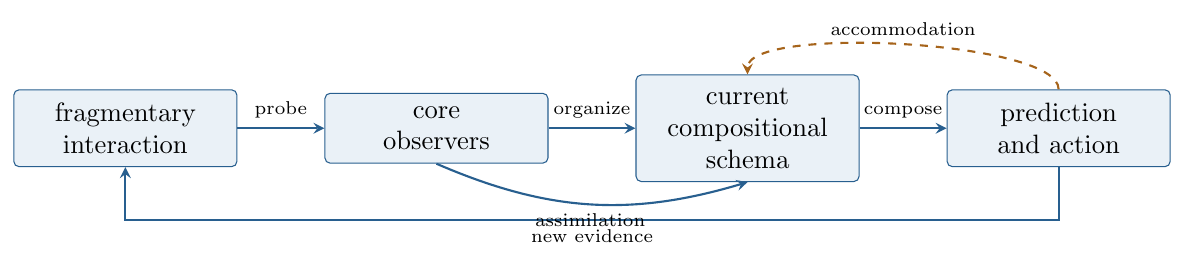
Assimilation incorporates a new encounter into an existing schema. A child who already treats cups as graspable may assimilate a newly encountered mug into that organization. Accommodation changes the schema when the encounter cannot be absorbed without distortion: the mug may be too hot to grasp, may have an unfamiliar handle, or may turn out to be a picture rather than a physical container. Learning alternates between using a structure and revising the conditions under which it applies.
The core-knowledge prior.
Spelke identifies six early-emerging systems concerning physical objects, approximate number, navigable space, object form, goal-directed agents, and social beings. These systems are automatic and domain-specific; they stand between raw perception and explicit concepts and beliefs, guide learning, and continue to operate in adults [ Spelke , 2022 , 2023 ] . Core knowledge does not tell the child which particular objects, people, languages, or rooms inhabit the world. It supplies initial distinctions through which evidence can become organized.
The two hypotheses separate where organization begins from how organization changes. Core systems provide typed entry points. Assimilation and accommodation provide a developmental update cycle. ORACLE will turn this separation into a learning architecture.
Drescher’s Made-Up Minds provides an important computational bridge between Piaget and this program [ Drescher , 1991 ] . His schema mechanism learns from experience by expressing discoveries in its current representational vocabulary and by extending that vocabulary with new concepts when necessary. It thereby turns constructivism into an explicit artificial cognitive architecture rather than leaving it solely as a developmental description. ORACLE is not a categorical restatement of that particular mechanism. It asks for foundations beneath the broader constructivist idea: what kinds of schemas compose, when two presentations express the same learned world, how a failed assimilation is localized, and which universal property licenses an accommodation. In this sense, the book seeks categorical foundations for compositional constructivism.