ora-0014
1.1 Categories and typed composition
A category \(\mathcal C\) consists of objects \(X,Y,\ldots \), morphisms \(f:X\to Y\), identity morphisms \(1_X\), and an associative composition
with identities acting neutrally.
The definition says which processes compose. It does not say that every pair of processes does, nor that a legal composite is useful, causal, or optimal. In ORACLE, the category itself may be the unknown predictive model. In UODL, its objects may be information states and its morphisms may be admissible decisions, evidence transports, or repairs.
11. The first reading habit throughout the book is type first. Before interpreting a formula, identify the source and target of every map. ↩
A composable pair
has a composite \(b\circ a:x_0\to x_2\). Associativity makes the result of a longer finite history independent of parenthesization. It does not imply that the composite was known before the two steps were observed.
A functor \(F:\mathcal C\to \mathcal D\) maps objects and morphisms while preserving identities and composition:
A functor is a compositional translation. A diagram of shape \(\mathcal J\) in \(\mathcal D\) is simply a functor \(D:\mathcal J\to \mathcal D\). The indexing category records the formal wiring; the functor supplies a realization.
Given \(F,G:\mathcal C\to \mathcal D\), a natural transformation \(\eta :F\Rightarrow G\) assigns a component \(\eta _X:F(X)\to G(X)\) to every \(X\) so that, for each \(f:X\to Y\),
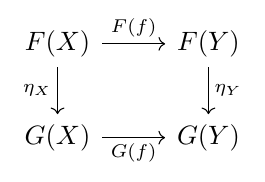
commutes.
Naturality is the first model of coherent change. Independently replacing the objects of a decision system does not define a repair unless the replacements respect the morphisms connecting them.