ora-0020
1.8 Simplicial sets and decision nerves
The simplex category \(\Delta \) has finite nonempty ordinals \([n]=\{ 0{\lt}\cdots {\lt}n\} \) as objects and monotone maps as morphisms.
A simplicial set is a functor
Its elements in \(X_n\) are \(n\)-simplices. Face maps delete vertices or compose adjacent steps; degeneracy maps insert identities.
The nerve of a category \(\mathcal C\) is the simplicial set
Thus an \(n\)-simplex is a composable chain of \(n\) morphisms.
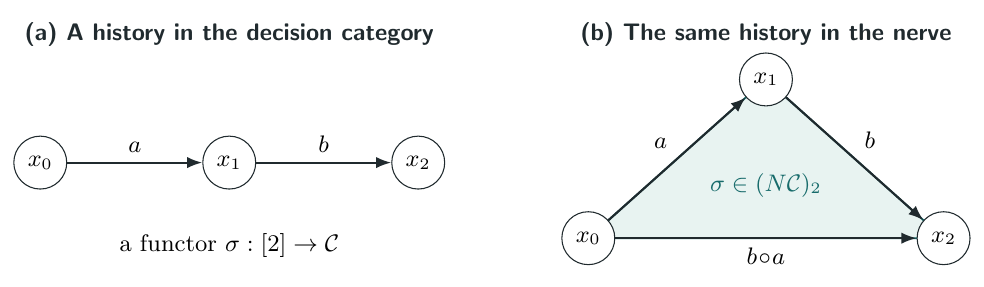
The first diagram below shows the first nontrivial case. Two successive decisions form a functor \([2]\to \mathcal C\). The corresponding 2-simplex remembers not only the two steps but also their composite and the witness that the triangular boundary coheres.
The nerve makes compositional depth intrinsic. Its \(n\)-skeleton \(\operatorname {sk}_nX\) is generated by simplices of dimension at most \(n\), and
External time and compositional depth are different indices. A learner may receive evidence without constructing a longer plan, or construct a longer internal plan before receiving new evidence.
In the simplest online protocol, one new decision morphism arrives per clock tick. A history observed from time \(0\) through time \(t\) is then a functor \([t]\to \mathcal C\), hence a \(t\)-simplex of the decision nerve. Its faces are the shorter histories obtained by omitting a time or composing adjacent steps, and its degeneracies insert identity decisions. The next diagram depicts this diagonal case \(n=t\).
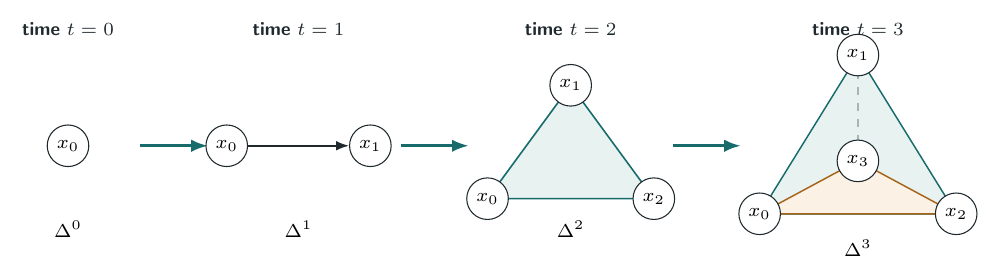
If \(\mathcal C\) is fixed, the clock does not enlarge the mathematical nerve \(N\mathcal C\); it enlarges the learner’s accessible simplicial subobject \(X_t\subseteq N\mathcal C\), generated by histories revealed through time \(t\). Multiple trajectories contribute multiple simplices and their shared faces. If the decision category itself is learned, both \(\mathcal C\) and its accessible nerve may change, and that extra repair must be declared.
11. The category of simplices \(\Delta /X\) has simplices \(\Delta ^n\to X\) as objects. It is the natural domain on which evidence, actions, losses, or warrants can decorate a decision nerve. ↩