ora-0023
1.11 Homotopy-coherent diagrams
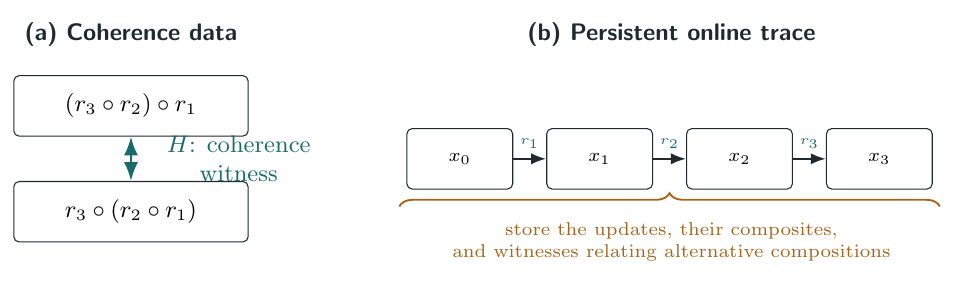
A strictly commuting diagram equates parallel composites. A diagram commuting up to homotopy instead supplies a path between them. A coherent diagram also supplies higher homotopies between the different ways of combining such paths. This compatibility continues through every dimension.
A category enriched in simplicial sets has a simplicial mapping object \(\mathcal C(X,Y)\) rather than a bare set of arrows. When these mapping objects are Kan complexes, the homotopy-coherent nerve produces a quasi-category. Ordinary categories appear as the discrete special case.
Why retain the higher data? Suppose three consecutive repairs can be composed in several orders. Equality in the homotopy category says only that the resulting composites represent the same class. A coherent online learner must also retain witnesses comparing the orders and the higher compatibility among those witnesses.