ora-0028
1.15.1 Differential categories are not tangent categories with extra axioms
1.15.1 Differential categories are not tangent categories with extra axioms
Three related abstractions must be kept distinct. A differential category is an additive symmetric monoidal category carrying a coalgebra modality \(!\) and a deriving transformation
satisfying categorical analogues of the differential laws. Its native semantics is linear and resource-sensitive. A Cartesian differential category instead equips each map \(f:A\to B\) with a derivative \(D[f]:A\times A\to B\), coherently with products, composition, and linearity in the direction argument. A tangent category begins from the geometry of tangent bundles and their iteration; it need not supply a global operator \(D[f]\) on every arrow.
These are connected constructions, not interchangeable definitions. The coKleisli category of a differential category is Cartesian differential. Under finite-biproduct and coreflexive-equalizer hypotheses, its coEilenberg–Moore category of \(!\)-coalgebras is a tangent category [ Cockett et al. , 2020 ] . Conversely, suitable differential objects or bundles over a fixed base in a tangent category form a Cartesian differential category under mild limit assumptions [ Cockett and Cruttwell , 2014 ] . Thus differential programming and differential geometry can be related without being collapsed.
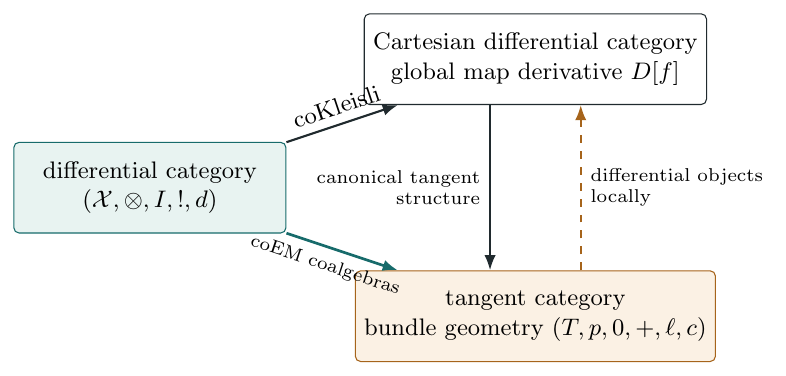
For ORACLE this distinction creates two identification levels. A learner may identify the tangent geometry visible in the world without identifying a differential presentation that generates it. Alternatively, it may posit \((\mathcal X,!,d)\) as the latent theory and regard the observed tangent world as its category of coalgebras. The second target is stronger: it must explain not only which infinitesimal variations exist, but why they arise from a particular resource-sensitive differential mechanism.
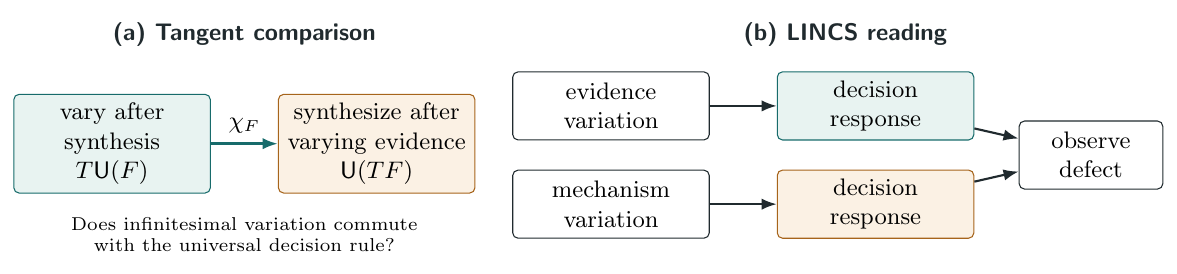
UODL separates variation of evidence from variation of the decision mechanism. For an ordinary universal construction, the desired comparison is
In homotopical semantics the tangent functor must preserve weak equivalences or admit a derived functor \(T^h\), giving
A discrete change of connected component in a repair space is not an infinitesimal motion. Tangent methods describe variation inside a local branch; component creation, deletion, or selection requires a registered repair.
LINCS adds a discipline around these comparisons: declare the typed structure, construct the relevant comparison map, observe its defect, propose a repair, and admit the repair through an independent criterion. A norm or loss may observe a defect, but does not define the structural defect by itself.