ora-0037
2.1.5 The Spelke sketch
2.1.5 The Spelke sketch
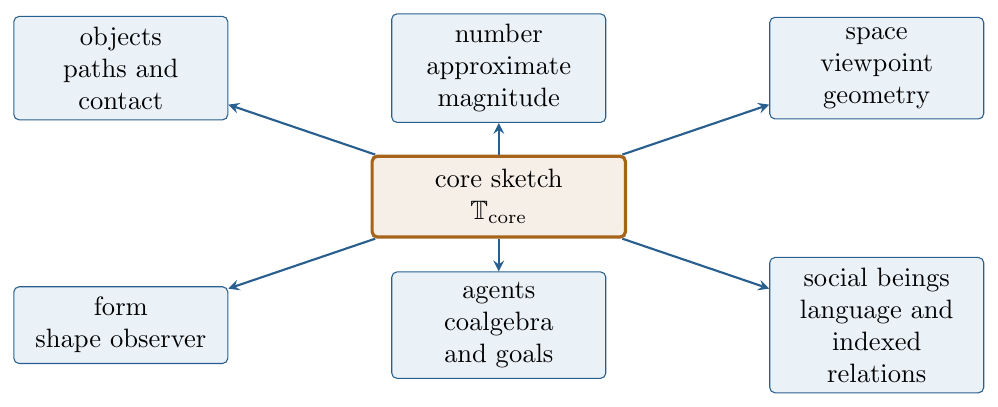
Spelke’s six systems do not all assert the same mathematical kind of structure [ Spelke , 2022 , 2023 ] . Treating each as one more object of \(\mathcal C\) would erase their empirical content. The core sketch instead combines internal objects and relations with observers into auxiliary categories. The following declarations are a first abstraction, not a claim that cognitive development implements these particular mathematical models.
Physical objects: persistence, paths, and contact.
The physical-object fragment declares a category \(\mathcal O\) of object states, an abstract interval or path construction, endpoint maps
and a class \(W\) of weak equivalences. An arrow in \(W\) says that two presentations preserve the same object for the probes at issue, despite a change of viewpoint, partial occlusion, or admissible deformation. Homotopies between paths express continuous alternatives that preserve this identity.
This relative category \((\mathcal O,W)\) is the minimal homotopical prior. A Quillen model structure may be imposed in a sufficiently complete realization to supply systematic factorizations and lifting arguments, but it should not be assumed without need [ Riehl , 2014 ] . Weak equivalence by itself does not express solidity, boundedness, or contact causation. For these, the sketch also declares a region or boundary observer and a contact subobject
Nonpenetration can be represented by forbidden fillers or exclusion conditions, while locality requires a physical-interaction arrow to factor through contact. Continuity, exclusion, and locality are therefore distinct parts of the prior.
Approximate number: magnitude before counting.
A natural numbers object would supply exact recursion and counting, which is stronger than the approximate-number system. The core declaration should instead begin with an ordered commutative magnitude structure
regarded as a thin symmetric monoidal category \(\mathbf Q\), together with a lax monoidal approximate-cardinality observer
A family of resolution-dependent relations \(\sim _\varepsilon \) records that two magnitudes may be indistinguishable at one scale and distinguishable at another. Exact counting may arise later by constructing a natural numbers object \(\mathbb N\) together with a comparison \(\mathbb N\to Q\). In this reading, the passage from rough magnitude to counting is an accommodation of the numerical fragment, not something built silently into its starting semantics.
Spatial geometry: coherent changes of viewpoint.
Let \(\mathcal V\) be a groupoid of viewpoints and admissible movements, and let \(\mathcal G\) be a category of geometric realizations. A spatial observer has the form
Functoriality says that successive changes of viewpoint compose coherently. The surrounding room is not identified with one retinal image; it is the structure invariantly reconstructed from a diagram of such images. Local charts, embeddings, and gluing conditions may enrich this fragment when the presentation exposes metric or topological information.
Object form: shape separated from identity.
The shape system is represented by a functor
Its target might record geometric form, a homotopy type, a group-action orbit, or a persistent descriptor. The essential declaration is controlled invariance: viewpoint changes that preserve an object should induce specified equivalences of shape, while a genuine deformation need not. The functor separates the question “is it the same persisting object?” from “does it have the same form?” without making those questions independent.
Goal-directed agents: coalgebra plus intention.
Autonomous evolution suggests an \(F\)-coalgebra
for each candidate agent. Coalgebra alone, however, describes behavior rather than intention. A goal-directed fragment must additionally declare goals and a comparison of paths toward them. Efficient behavior may be expressed by a cost-enriched hom-category, a preferred object in a goal-directed comma category, or another universal comparison appropriate to the realization. The prior says that some observed trajectories admit coherent goal-directed explanations; it does not identify prediction of motion with proof of intent.
Social beings: indexed relations, not merely labels.
A poset can represent hierarchy, information refinement, trust, or affiliation, but cannot by itself express reciprocal communication and changing attention. A more general declaration is an indexed category
whose fiber over a context records identities and social relations. Its reindexing functors record contextual change. Groupoidal structure may track persistent identity, while poset enrichment records ordered evidence or trust. Temporal indexing can then distinguish a durable relationship from a momentary attentive or emotional state.
Language: a constrained coalgebra of communication.
Language belongs inside the social fragment because it communicates reference, information, goals, and intentions between agents. A coalgebraic presentation writes a candidate language as
where a state records the residual linguistic and pragmatic possibilities after a fragment has been heard. When a final coalgebra exists, the unique behavior map \(L\to \nu F_{\mathrm{lang}}\) realizes those indefinitely extensible responses. Productive syntax retains a complementary algebraic aspect: expressions are assembled compositionally even as their observable behavior unfolds coinductively.
Moro’s study of impossible languages makes the restriction in this prior empirically substantive [ Moro , 2023 ] . The class of formally specifiable grammars is larger than the class the human brain can acquire as language. ORACLE should therefore not search all \(F_{\mathrm{lang}}\)-coalgebras, but a declared subcategory
On this reading, universal grammar specifies the admissible signature, endofunctor, and invariants; interaction identifies the particular language coalgebra. A speech-sensitive observer first converts a structured acoustic stream into candidate linguistic evidence, while dialogue probes test whether the inferred behavior coherently changes shared social information. Language is thus not a seventh isolated core system. It is a learned coalgebraic interface through which the other core systems become communicable.