ora-0075
4.13 Equilibration as a repair process
Piagetian equilibration is not a return to a static endpoint. It is the process of restoring coherence after interaction exposes a mismatch among a realization, its observers, and its cross-fragment warrants. Let \(\delta (M,T')\) be a typed defect object, not necessarily a scalar. Its components may include a failed lift, an unfillable horn, an incompatible overlap, or an observer-visible discrepancy.
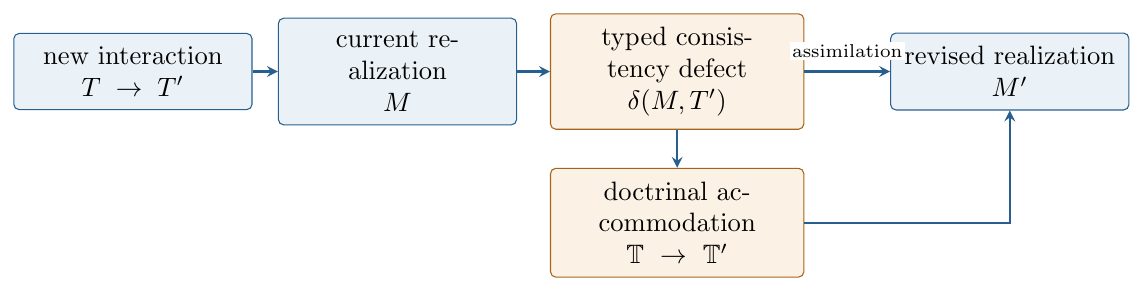
Repair is successful when it maps the defect to a declared zero or admissible residual object while preserving the settled query subtheory. This formulation connects Piagetian development to the later homotopy and tangent repair chapters without pretending that all cognitive disequilibrium is numerical optimization.