ora-0090
6.2 State, probes, and dependent update
A useful machine state must retain more than a current model. We write
where \(T_t\) is the transcript, \(\mathbb T_t=d(T_t)\) is the current doctrine, \(\widehat M_t\) is the selected realization, \(\mathcal Q_t^{\mathrm{set}}\) records answers the learner has warranted, \(\mathcal F_t\) is the residual version fiber, and \(\Delta _t\) is the registered defect or repair context. This is a typed state: changing \(T_t\) changes the fiber in which the next state lives.
A UOCL algorithm for an instance consists of three partial realizers:
Here \(\Pi _t\) is a probe policy, \(\operatorname {Sel}\) chooses an admissible assimilation lift, and \(\operatorname {Rep}\) performs ordinary or doctrinal accommodation when assimilation is unavailable or inadequate. The realizers may be deterministic, randomized, or set-valued, but their type and admissibility obligations must be explicit.
The partiality is essential. A learner may abstain because the evidence is insufficient, because its selection problem is not effectively solvable, or because a registered obstruction requires accommodation. Treating all three cases as an arbitrary guessed model would erase the distinction between ignorance and inconsistency.
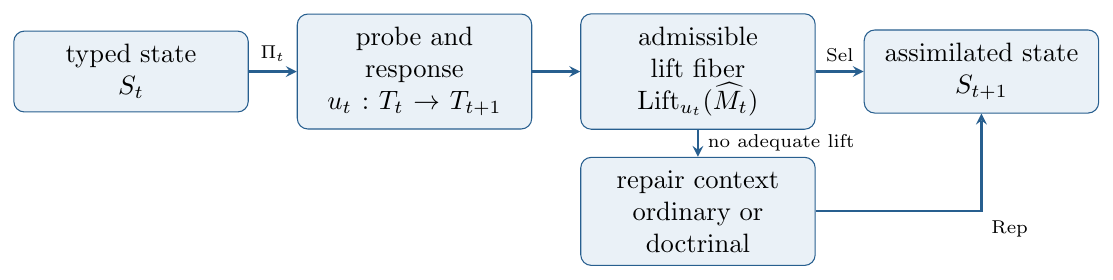
Suppose \((M_{t+1},\alpha _t)\in \operatorname {Lift}_{u_t}(M_t)\) is selected and \(\alpha _t\) is conservative on \(\mathcal Q_t^{\mathrm{set}}\). If \(M_{t+1}\) satisfies the extended transcript, then the update preserves every settled answer and is sound for the new evidence.
Soundness for the new evidence is the defining membership condition for \(H_d(T_{t+1})\). Reindexing compares the new realization with the old one, and conservativity makes that comparison an equivalence under every settled query. Hence no previously warranted answer changes.