ora-0125
9.16.1 Flow reasoning as learned fixed-point search
9.16.1 Flow reasoning as learned fixed-point search
Flow Reasoning Models (FRMs) provide a particularly relevant learned search mechanism for this solution object [ Helbling et al. , 2026 ] . They represent a discrete structured answer by a continuous, directly decodable state and self-condition the denoiser on its previous prediction. For fixed puzzle conditioning \(c\), flow state \(x_\tau \), and flow time \(\tau \), write the recurrent refinement as
The recurrent index \(k\) is reasoning depth. It is distinct from the continuous flow coordinate \(\tau \), so FRM inference naturally carries the bifiltration \((\tau ,k)\) anticipated by the decision-nerve semantics.
Let \(S_{c,\tau }\) be the recurrent state object and abbreviate the held-state update by \(\Phi :S_{c,\tau }\to S_{c,\tau }\). Its fixed-point object is the equalizer
Let \(Y_c=\prod _{v\in V}C_v(c)\) be the object of all given-compatible grids, let \(d:\mathsf{Fix}(\Phi )\to Y_c\) decode a recurrent fixed point, and let \(i:\mathsf{Sol}_{\mathrm{Sud}}(c)\hookrightarrow Y_c\) be the constraint inclusion.
The recurrent reasoner is sound for \(c\) when its decoder factors through the universal solution object:
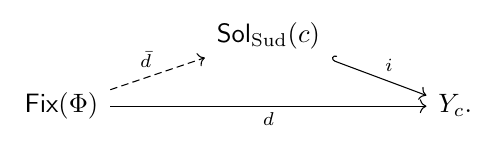
It is solution-complete when the restriction of \(\bar d\) to the declared attracting fixed points covers the solution object. It is exact when that comparison is an isomorphism, or an equivalence after the declared semantic localization.
The factorization is an admission condition, not a consequence of recurrent convergence. A state can satisfy \(\Phi (s)=s\) and still decode to an invalid grid. This separates two defects that are often conflated:
A spurious fixed point has vanishing dynamical defect but nonvanishing constraint defect. Sudoku is valuable precisely because \(\delta _{\mathrm{con}}\) is independently and exactly observable without knowing the intended solution in advance.