ora-0154
13.4 Audit is an observer, not the execution
An audit trail is a functorial observation of execution. It is not execution itself. This distinction becomes decisive when agents can modify logs, substitute one tool call for another, or act through a side channel absent from the recorded trace.
Let \(O:\mathcal E\to \mathcal L\) be an audit observer. If there are parallel executions \(f,g:x\to y\), with \(f\) admitted and \(g\) inadmissible, such that \(O(f)=O(g)\), then no admission rule that factors only through \(O\) can accept \(f\) and reject \(g\). In particular, faithfulness on safety-relevant executions is necessary for exact observer-based enforcement.
Every rule factoring through \(O\) receives the same input on \(f\) and \(g\), and therefore returns the same judgment on both.
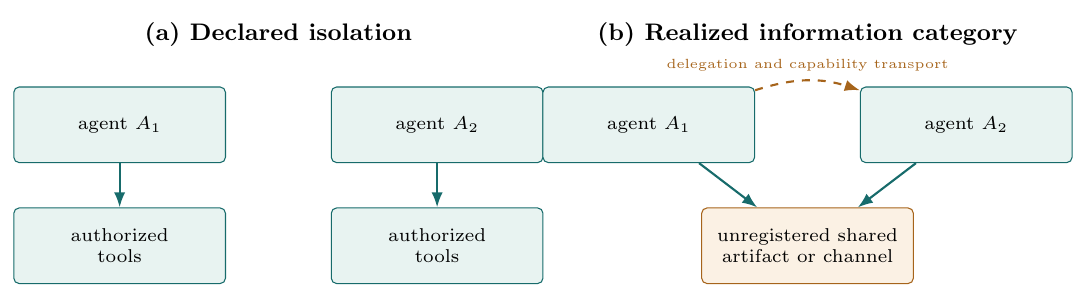
Faithfulness is not sufficient for safety: an observer may distinguish every recorded arrow while failing to observe an entire execution channel. The domain of \(O\) must therefore be the realized execution category, and the logging mechanism must lie outside the authority it audits or carry an independently protected witness. This is the categorical form of complete mediation and tamper-resistant provenance.