ora-0180
16.1 Environment morphisms and knowledge packages
An environment must expose more than a task label. Write
for its information, action, and consequence categories, query doctrine, observer, and safety subobject. An environment morphism \(f:E\to E'\) contains functors between these components together with comparison cells for the decision declaration. It may forget information, refine actions, change the clock, or transport consequences; each variance must be stated.
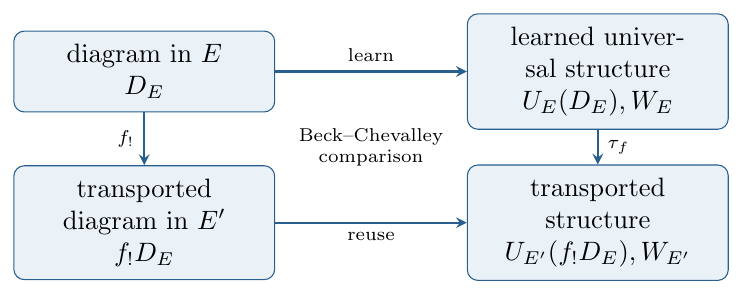
A structural knowledge package over \(E\) is a tuple
where \(D_E\) is a learned diagram or categorical presentation, \(U_E\) is a universal construction on it, \(W_E\) is its universal witness, \(R_E\) is a family of repair types and certificates, and \(Q_E\) is the observational quotient on which the package is claimed to be valid.
For \(f:E\to E'\), an admissible transport \(\tau _f:K_E\rightsquigarrow K_{E'}\) consists of:
a transport of the learned diagram and its settled subdiagram;
an invertible Beck–Chevalley mate comparing the two orders of transport and extension;
a coherent image of the universal witness and registered repair types;
an observer comparison preserving the quotient \(Q_E\); and
a safety comparison landing in \(\mathcal S_{E'}\).
For tangent knowledge, it additionally includes an invertible comparison \(T\tau _f\Rightarrow \tau _fT\) on the admitted tangent structure.