sec-pacc-collider
8.2.1 Running example: PACC collider identification
8.2.1 Running example: PACC collider identification
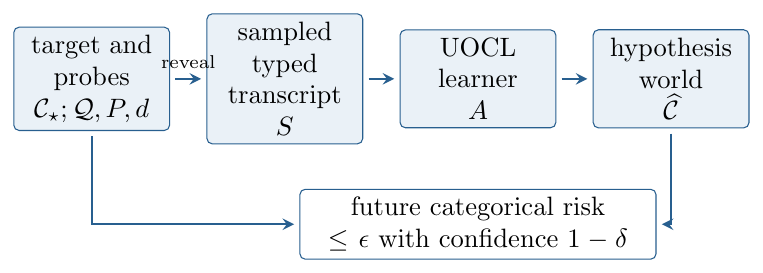
The collider declaration gives a non-discrete instance of categorical risk. Let \(P\) be a distribution over admitted experimental contexts and let \(d_p\) be a bounded discrepancy between predicted and observed outcome laws for probe \(p\), such as a normalized divergence on binned event distributions. For a target response semantics \(H_\star \), define
A PACC collider learner returns \(\widehat H\) whose error is at most \(\epsilon \) with transcript probability at least \(1-\delta \). This claim is relative to \(P\): a rare energy regime or unmeasured channel can carry substantial structural disagreement while contributing almost no average risk. Coverage conditions are therefore part of the scientific prior, not a technical afterthought.
Nor does small collider risk establish ontological identity. It establishes approximate equivalence of the declared response semantics on the weighted probe family. Recovering generators, relations, or symmetry doctrine requires stronger structural probes of the kinds distinguished in Definition 8.6.