sec-topos-world-models-uocl
5.3 Topos World Models from documents
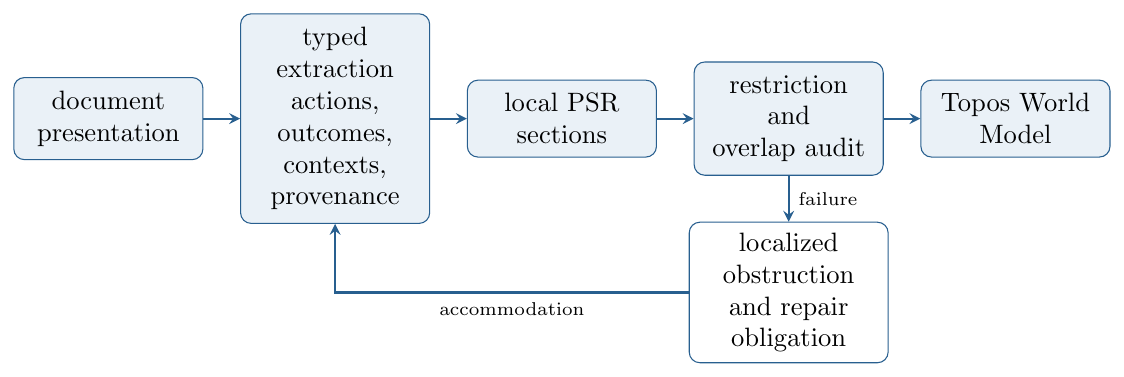
Prometheus and Odyssey provide a less conventional UOCL specialization. The presentation is not initially an action–observation trajectory. It is a growing corpus of papers, reports, manuals, reviews, data summaries, and other research artifacts. A compiler extracts typed fragments—entities, contexts, claims, candidate actions or interventions, reported outcomes, and provenance—and organizes them into local action-oriented predictive-state models. Prometheus introduced this construction as a Topos World Model; Odyssey places it inside a larger foundry whose intermediate artifacts, admission decisions, and repair obligations remain inspectable [ Mahadevan , 2026e , 2026d ] .
Fixed doctrine.
The pipeline presupposes a site or context category, local predictive-model fibers, restriction maps, a provenance discipline, and a gluing semantics. Its internal constructions are typed extraction, local PSR update, and descent. The resulting guarantees are therefore conditional on documents being compilable into those types and on compatibility over the chosen cover being the right notion of global coherence.
The word action-oriented is deliberate. A document fragment such as “under condition \(U\), action \(a\) was followed by outcome \(o\)” can constrain a test \(\tau =(a,o)\), even when the learner did not execute \(a\). Text can therefore present predictive and causal claims about actions. It cannot, by extraction alone, establish that those claims identify causal effects. Interventional semantics still require provenance, design or identification assumptions, and consistency across sources. UOCL cleanly records this boundary by typing textual support, predictive adequacy, and causal warrant as different doctrines.
Let \(\mathcal C\) be a category of overlapping contexts and let
assign to each context \(U\) a local predictive model \(\mathcal S(U)\). Restriction maps express what one local model says on a shared subcontext. When compatible local sections glue, the result is not one unqualified global state vector but a coherent atlas of context-indexed predictive states. This is the topos-theoretic refinement of the PSR idea: local predictive quotients become objects in a presheaf or sheaf world rather than coordinates in a single globally privileged model.
Suppose \(\{ U_i\to U\} \) is a cover, the local predictive sections \(s_i\in \mathcal S(U_i)\) agree on every overlap, and restriction commutes with the admitted PSR updates. If \(\mathcal S\) is a sheaf, the local states determine a unique glued section \(s\in \mathcal S(U)\). Any later compatible update that preserves a settled local query preserves its glued answer.
Existence and uniqueness of \(s\) are the sheaf gluing axiom. Commutation of restriction with update makes the updated family compatible. Its unique gluing restricts to the updated local sections; hence any query unchanged on the cover is unchanged in the glued section.
The UOCL reading is now precise. Documents are successive presentation fragments; the local PSRs are hypotheses in context-indexed fibers; new documents induce updates and possible refinements of the cover; restriction maps express comparison; gluing is coherent assimilation; and an incompatible overlap registers an accommodation problem. Prometheus/Odyssey therefore extends classical PSR identification in two directions at once: from executed trajectories to heterogeneous textual presentations, and from one predictive state space to a sheaf of locally valid, provenance-bearing predictive worlds. It is a concrete instance of UOCL, while remaining only one possible algorithmic realization of the broader ORACLE program.
Doctrinal boundary.
Changing an extracted claim or refining a local PSR is internal repair. Changing the context cover may still be a controlled structural refinement. Rejecting the assumed restriction maps, sheaf condition, provenance types, or separation between textual support and causal warrant changes the doctrine under which the Topos World Model was assembled.