ifc-0014
0.11 Classical double Lie algebroids: a concrete realization
A single tangent direction describes one kind of local variation. Creativity, however, often couples two qualitatively different processes: repair inside a maintained organization and a probe of how that organization itself might have to change. A double vector bundle provides the elementary square in which two such directions can coexist:
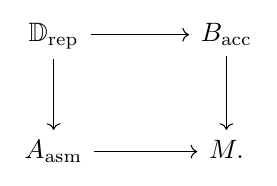
Read the square from the bottom upward. A point of \(M\) is a maintained theory state. The two side bundles list two different kinds of locally available move at that state. The object at the upper left records a compatible pair of moves and any mixed information visible only when both are considered. The first question is therefore not “what does the algebroid optimize?” but “does the result depend on the order in which the two kinds of move are applied?” The bracket and interchange constructions below type that order effect.
Here \(M\) is a space of maintained theory states. We interpret \(A_{\mathrm{asm}}\) as locally available assimilatory repairs and \(B_{\mathrm{acc}}\) as proto-accommodative directions that test a possible reorganization. The labels are an application-level semantics, not part of the abstract definition. The total space \(\mathbb D_{\mathrm{rep}}\) records their joint variation. Its core \(K\) contains mixed directions that project trivially to both sides and can therefore encode interaction data invisible in either repair class alone.
In the classical category of smooth manifolds, Mackenzie’s definition equips a double vector bundle with compatible Lie-algebroid structures whose compatibility is expressed through double-vector-bundle duality [ Mackenzie , 2000a ] . This is substantially stronger than placing two unrelated brackets on a square. When these conditions hold, the square is a double Lie algebroid. Meinrenken and Pike associate to it a bigraded cochain Weil algebra
with horizontal and vertical differentials of bidegrees \((1,0)\) and \((0,1)\) [ Meinrenken and Pike , 2021 , Pike , 2020 ] . Their classical Weil-algebra criterion states that the two VB-algebroid structures form a double Lie algebroid exactly when these differentials supercommute [ Meinrenken and Pike , 2021 , Theorem II ] . For the creativity interpretation, write these differentials as \(d_{\mathrm{asm}}\) and \(d_{\mathrm{acc}}\).
Their graded commutator defines the creative interchange obstruction
A nonzero value says that “assimilate, then probe accommodation” disagrees with “probe accommodation, then assimilate.” Given a representation and a declared localization observer, it can localize an order effect between repair processes. It is evidence that their current coupling is not a compatible double structure; it is not yet the content of a replacement theory. Internally, the proposed tangent-categorical double construction has an interchange defect \(\Theta _{\mathrm{int}}\); \(\Omega _{\mathrm{cre}}\) is its classical cochain realization when the required bridge exists.
Chapter 3 develops the canonical tangent- prolongation example, the vacant matched-pair case, and the splitting-dependent description by 2-term representations up to homotopy. For the primer, the essential point is only that double compatibility contains strictly more data than two unrelated local update rules.
. A proto-accommodative direction is not an admitted accommodation. The classical double Lie algebroid realizes local interaction and its obstruction; the proposed internal object records the corresponding tangent-categorical comparison. A presentation-level theory change is recorded separately by a finite sketch map\[ J:\mathbb S\longrightarrow \mathbb S^+, \]together with transport of old models and an independent admission record. More general accommodation is recorded by an admitted package comparison; when the presentation changes, the sketch map states that language-level component of the jump. The infinitesimal geometry diagnoses pressure for either change.
For later use, call
a double repair package. It adds interacting repair geometry to the differential representational package without replacing its observers, generators, or admission procedures. The entries following the semicolon belong to the classical cochain realization and are present only when that realization has been supplied.