ifc-0020
1.2 Four routes into a domain
Four acquisition routes should be distinguished. The first three supply new evidence directly; the fourth reuses a theory acquired elsewhere and therefore enters the acquisition map through \(\mathfrak R_{\mathrm{prior}}\).
- Explicit instruction.
A teacher directly names objects, relations, rules, goals, or invariants. The learner receives part of the declaration in symbolic or linguistic form: a racket strikes a ball; a legal serve begins behind the baseline; quantity is preserved when liquid is poured without loss.
- Imitation.
The learner observes one or more competent performances and reconstructs a task theory from their regularities. It must infer which entities play stable roles, which actions compose, and which apparent details are incidental.
- Apprenticeship.
The learner acts in the task while a teacher selects examples, redirects attention, corrects actions, supplies explanations, and introduces counterexamples. The evidence is interactive and depends on the learner’s current theory.
- Theory transport.
The learner imports a typed construction from an earlier domain through an analogy, ontology alignment, or explicit theory map. The imported structure is provisional: its source types, preserved relations, and unsupported target-side assumptions must remain visible.
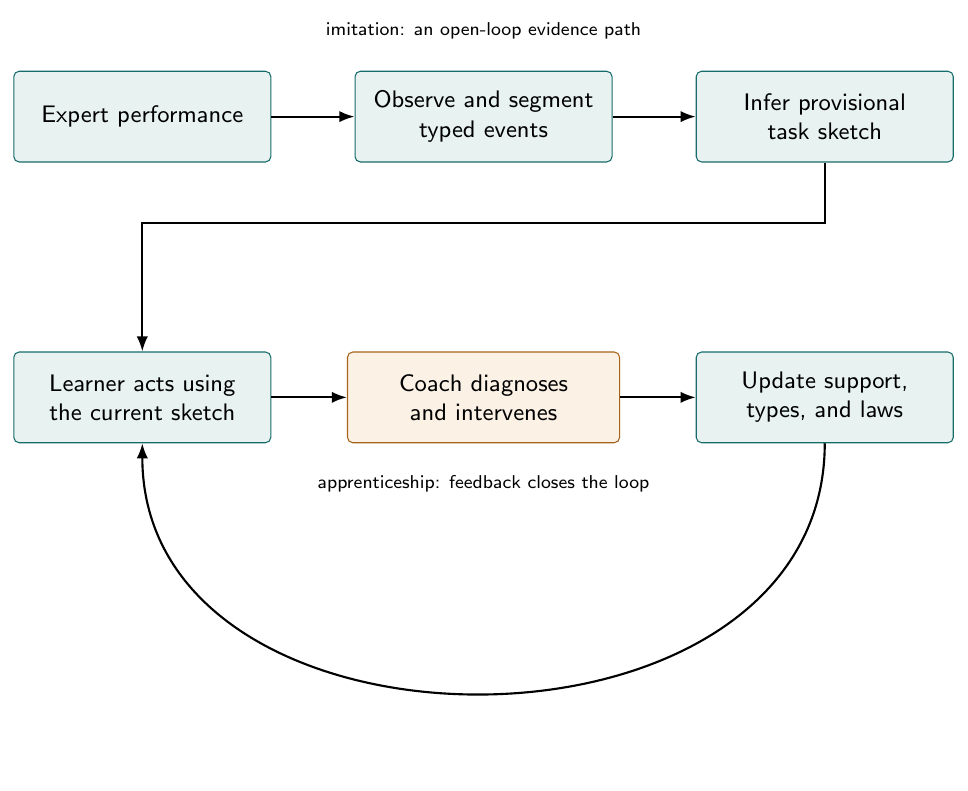
The distinction between imitation and apprenticeship is structural, not merely terminological. Under imitation, the evidence can be represented as a fixed family of expert traces
Under apprenticeship, the teacher observes a learner trace \(\tau _t^L\) and returns a context-sensitive intervention
which may correct an action, identify a missing precondition, contrast two cases, or amend the learner’s explanation. The next evidence therefore depends on the current learner. Apprenticeship is a closed-loop acquisition process.
Modern literature sometimes uses apprenticeship learning for learning from demonstrations, including inverse reinforcement learning [ Abbeel and Ng , 2004 ] . This book uses the narrower distinction above because teacher feedback changes the acquisition problem. Passive traces reveal what an expert did; coaching can reveal why an action was chosen, which latent error the learner made, and what it should attend to next.