ifc-0049
3.6 Double-infinitesimal repair geometry
Weil profiles describe families of probes, but they do not yet distinguish two repair processes or explain how those processes interact. For that purpose, let
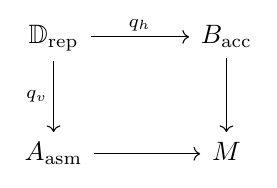
be a double vector bundle. Its horizontal and vertical vector-bundle structures commute. The side bundle \(A_{\mathrm{asm}}\to M\) represents assimilatory directions; \(B_{\mathrm{acc}}\to M\) represents proto-accommodative directions. The application, not the double-vector-bundle axioms, supplies these meanings.
The canonical projection
forgets joint information. Its kernel over the zero sections is the core \(K\to M\). Core elements project trivially to both side bundles. The core is therefore a candidate carrier of mixed corrections: under an application semantics, an assimilatory repair may alter the meaning of an accommodative probe even when neither side records that effect alone. This interpretation is additional structure, not a consequence of the double-vector-bundle axioms.
In a classical smooth model, equip each direction with a VB-algebroid structure.
This gives horizontal and vertical differentials on Meinrenken–Pike’s bigraded cochain Weil algebra
Because both differentials have odd total degree, their graded commutator is
Let \(\mathbb D_{\mathrm{rep}}\) be a double vector bundle equipped with VB-algebroid structures over both side bundles. The two structures make \(\mathbb D_{\mathrm{rep}}\) a double Lie algebroid if and only if their horizontal and vertical differentials on the bigraded Weil algebra supercommute, equivalently \(\Omega _{\mathrm{cre}}=0\) [ Meinrenken and Pike , 2021 , Theorems II and 8.2 ] .
The theorem supplies a clean diagnostic interpretation in the classical realization. If \(\Omega _{\mathrm{cre}}\neq 0\), the candidate pair is not yet a double Lie algebroid. The two local repair semantics are incompatible. Once a representation and localization rule have been fixed, the value and support of \(\Omega _{\mathrm{cre}}\) can identify an algebraic locus where the two processes fail to supercommute. Treating that locus as a repair frontier requires a declared observer connecting the residual to task semantics. A model can observe this typed defect through a scalar norm or statistical test, but the obstruction itself is the bidegree-\((1,1)\) operator. At the internal tangent-categorical level, the corresponding diagnostic is \(\Theta _{\mathrm{int}}\); identifying it with \(\Omega _{\mathrm{cre}}\) requires the cochain realization described above.
A coordinate model of a missing mixed direction.
The smallest useful picture lives on \(M=\mathbb R^3\). Let two locally available motions be
At the origin, the registered side directions span only the \(x\)- and \(y\)-axes. Their bracket is
so an infinitesimal loop that follows \(X\), then \(Y\), then reverses the two motions produces a second-order displacement in a direction absent from the original side span. The \(z\)-direction is the elementary coordinate shadow of mixed information that neither side reports alone.
This example is not itself a DIAL object, and a nonzero bracket is not yet a creative event. It shows only the geometric question that the double repair construction types more carefully: does an order effect close inside the declared representation, disappear under the registered observer, or expose a persistent direction for which the current theory has no expression?
A double repair geometry consists of a candidate DIAL object and, when available, a classical double-vector-bundle realization \(\mathbb D_{\mathrm{rep}}\) with candidate horizontal and vertical VB-algebroid structures. It also includes a chosen finite family of tangent-probe observables and an admission semantics for deciding whether an observed interchange defect is persistent.
This definition intentionally allows incompatible candidates. Internally, a compatible DIAL object is the zero-\(\Theta _{\mathrm{int}}\) case. In the classical cochain realization, a compatible double Lie algebroid is the zero-\(\Omega _{\mathrm{cre}}\) case. Either defect may motivate repair of the coupling, enrichment of the core, or a larger theory change.
The canonical example is the tangent prolongation of a Lie algebroid \(A\to M\):
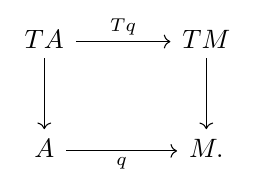
Its double Weil algebra recovers the Weil algebra of \(A\) [ Meinrenken and Pike , 2021 ] . This makes the construction more than a formal analogy: a Lie algebroid of creative skills can be tangent-lifted, so one direction represents available skills and the other their variation across theory states. Chapter 4 develops that connection.
. Use the double structure to compare local repair orders, not to smuggle a finite theory change into tangent notation. The creative interchange obstruction localizes what the current coupled geometry cannot reconcile. A candidate repair must first persist and integrate into a coherent finite realization. If the old theory cannot support such a realization, a proposal engine may express a replacement as a finite sketch extension \(J:\mathbb S\to \mathbb S^+\); admission must then test its transport and new consequences.