ifc-0051
3.7.1 Two flows rather than one
3.7.1 Two flows rather than one
The double structure suggests two vector fields on a chosen realization of the theory-state object,
representing assimilation and proto-accommodation. This notation presupposes that the relevant sections of the two side algebroids have been realized as vector fields on a common state object. A double Lie algebroid does not supply that realization automatically; anchors, sections, and the required integrability conditions are part of the application contract.
When both fields are complete, they induce flows \(\Phi _{\mathrm{asm}}\) and \(\Phi _{\mathrm{acc}}\). Their interaction compares the two orders
If the flows commute, the two directions assemble into a coherent local two-parameter evolution
Classically, commuting flows correspond to vanishing Lie bracket under the usual completeness hypotheses; Cockett, Cruttwell, and Lemay establish the tangent-categorical relation between commuting vector fields and commuting flows. For DIAL, this gives geometric meaning to the mixed comparison: compatibility says that the infinitesimal rectangle closes. A nonzero interchange defect says that assimilating and probing accommodation in the opposite order lead to distinguishable states.
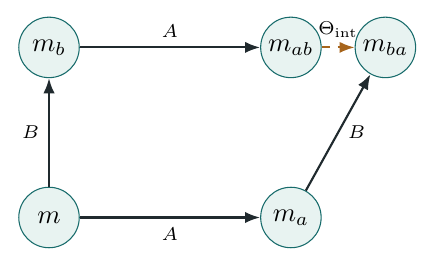
This interpretation connects the formalism to the approximate holonomy experiments described later. A finite empirical realization estimates the discrepancy around small rectangles rather than observing an abstract bracket directly. Shrinking-loop behavior tests whether the discrepancy is consistent with a local interchange obstruction, while uncertainty estimates guard against declaring a structural defect from sampling noise.