ifc-0061
4.2 The Lie algebroid of creative moves
A Lie algebroid consists of a vector bundle
a Lie bracket \([\cdot ,\cdot ]_A\) on sections, and an anchor
satisfying, for sections \(s,t\) and \(f\in C^\infty (M)\),
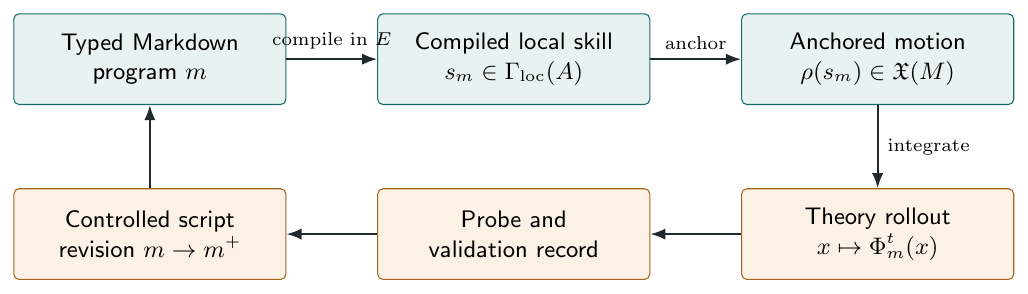
the Leibniz rule and anchor–bracket compatibility [ Mackenzie , 2005 ] . At a theory state \(x\in M\), the fiber \(A_x\) contains locally available, typed skill directions. For a compiled section \(s_m\), execution produces the infinitesimal theory motion
When this vector field integrates over an interval, it produces a finite rollout \(x\mapsto \Phi _m^t(x)\). The rollout may edit a conjecture set, add a candidate interface, select an experiment, compare two mechanisms, or update a status-bearing extension dossier.
The three pieces have different semantics:
- Base \(M\).
The maintained semantic states of the current theory.
- Fiber \(A_x\).
Skills available locally at state \(x\), including their type, permissions, and provenance requirements.
- Anchor \(\rho \).
The observable change in the theory state induced by executing a skill direction.
The vector-space structure in each fiber is a modeling commitment, not a property of skill names. It is justified only when local coefficients and linear combinations have an operational semantics—for example as mixtures, rates, or a declared continuous relaxation. Otherwise the Lie algebroid is a local surrogate for the compiled effects, and the compiler must record which discrete executions realize the sections being compared.
This is richer than placing independent coordinates on a prompt. Availability can vary with the state: a proof skill may become legal only after the necessary definitions exist; a simulator intervention may be available only where its mechanism is exposed; and a proposed analogy may be inadmissible until its source and target types have been registered.