ifc-0081
5.8.2 A Beck–Chevalley interpretation of double interaction
5.8.2 A Beck–Chevalley interpretation of double interaction
There may nevertheless be a deeper relation between DIAL and Kan extension. Suppose a finite extension proposal and a change of context, evidence, or realization form a commutative square of presentations
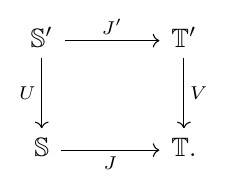
Here the horizontal maps represent a proposed extension and its transported counterpart; the vertical maps represent a second registered change. Whenever the relevant adjoints exist, the commutative square generates a Beck–Chevalley mate, schematically
It compares changing context before extending with extending before changing context. If \(\beta \) is invertible, the two composites are naturally isomorphic. If it is not, failure of this particular exactness comparison records a global order dependence relative to the chosen square and adjunctions. Which direction of the mate is relevant depends on the chosen variance and adjunctions; a diagram alone does not supply a preferred learning semantics.
This suggests a research hypothesis rather than an established result. For a DIAL object that integrates to such a square, the internal interchange defect \(\Theta _{\mathrm{int}}\) may be an infinitesimal shadow of the failure of an appropriate Beck–Chevalley mate to be invertible. Under a classical cochain realization, its observer \(\Omega _{\mathrm{cre}}\) would then measure the first-order incompatibility of the two finite transport orders. Symbolically, one would seek a realization in which
with the arrows defined by an actual integration and realization theorem. No such theorem is assumed here. In particular, the two DIAL side directions are semantic data and need not integrate to theory maps at all.
Boundary: DIAL-Kan hypothesis. The proposed relationship is not that DIAL is a Kan extension. Kan extension supplies global universal transport once a theory or context map is known. DIAL supplies local two-direction geometry and an interchange diagnostic. A future integration theorem would relate the latter to the infinitesimal component of a Beck–Chevalley comparison.