ifc-0174
13.2 The RELIC target card
RELIC specializes the DIAL-X contract to sequential decisions. Its three targets are
The operational target \(Y_{\mathrm{dec}}\) is a deployable policy together with any persistent state or macro-actions it requires. The structural target \(\mathbb S_{\mathrm{dec}}\) declares the types, factorization, temporal interfaces, and observable obligations of that policy. The epistemic target \(\mathcal C_{\mathrm{dec}}\) combines task completion, validity, counter-witnesses, transport, and conservative abstention.
The RELIC creative mandate freezes that decision sketch, its primitive action and observation interfaces, stage grammar, and reference library of admitted policies and schemas. A new composition of registered stages is combinational; a new reachable policy inside the same package is exploratory; and a change to the registered decision package is transformational. Return and novelty remain separate observers.
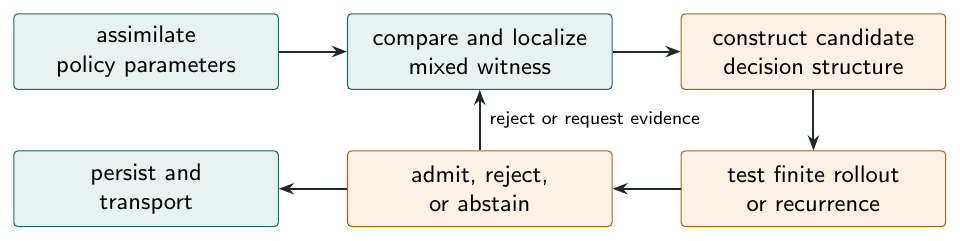
Operationally, RELIC receives interaction traces, the maintained decision sketch, and the currently registered observation and primitive-action interfaces. It returns a deployable policy together with any persistent state, schema predicate, macro-action, or proposed declaration change that the policy requires. A finite-rollout record and a status-bearing admission record accompany that output; when the evidence cannot distinguish structural inadequacy from ordinary policy error, the correct output is abstention or an evidence request.
In the notation of Chapter 10, \(\mathbb A_{\mathrm{RELIC}}\) presents critic, policy, and action updates inside the maintained decision language, while \(\mathbb B_{\mathrm{RELIC}}\) presents probes and revisions of state, schema, or temporal structure. Their realizations perform within-declaration learning and propose decision-language change, respectively. The observer family records reward, validity, memory, and factorization evidence; \(\Theta _{\mathrm{RELIC}}\) compares the two orders; \(\gamma _{\mathrm{dec}}\) tests finite execution; and \(\mathsf{Adm}_{\mathrm{RELIC}}\) assigns status on disjoint games or traces.
The finite-realization observer \(\gamma _{\mathrm{dec}}\) is distinct from that final certificate family. It asks whether a local policy repair remains coherent over a finite rollout, recurrence, or temporally extended execution, including the state and memory transport required by the candidate decision structure. A one-step reward gain that fails this observer is not eligible for admission.
For the present studies, \(\mathsf{Ctl}_{\mathrm{RELIC}}\) registers current and no-change policies, stronger fixed-declaration learning, generic intrinsic and goal-relevant exploration, isolated structural actions, saved-state restoration, reordered and type-invalid programs, and observation or memory alternatives. Only after the applicable controls fail under the stated contract may RELIC propose a package comparison
As with skill construction, its presentation component \(J\) does not itself move policy state or memory. A RELIC proposal must also record a supplied or induced semantic transport \(\bar J_{\mathrm{dec}}:M_{\mathrm{dec}}\to M_{\mathrm{dec}}^{+}\), together with the policy-state and memory lift over it.
The RELIC artifact dossier consequently contains more than the deployed policy. It records the constructed temporal composition or task-stage operator, its package comparison \(\Upsilon _{\mathrm{RELIC}}\), the state and memory transported into the new policy language, disjoint-game admission and confirmation results, and a replayable version of the resulting program. The strongest experiments below admit such constructions up to behavioral equivalence inside registered primitive actions and stage contracts; they do not establish invention of a new primitive action or observation type.
For the experiments in this chapter, the horizontal direction is learning or acting inside the current policy language. The vertical, proto-accommodative direction probes or proposes a change to the language: a state coordinate, schema predicate, or temporally extended composition. Only a finite proposal that passes realization and admission is installed as accommodation. Their mixed question is operational:
A repeated action, Bellman inconsistency, non-Markov residual, or failed factorization can make the disagreement observable. None of these witnesses automatically licenses accommodation. It localizes pressure on the current model and triggers a proposal, finite-realization, and admission process.