ifc-0186
14.3 A small algebra of workflow composition
The first implementation needs only a finite orchestration sketch with four constructors.
- Sequential composition \(B\circ A\).
The output packet type of \(A\) matches the input contract of \(B\), and the composite retains both component admission records and a separate admission record for the interface between them.
- Parallel composition \(A\otimes B\).
Two workflows examine the same versioned state under a declared policy for merging compatible proposals and preserving incompatible ones as alternatives.
- Guarded choice \(A\mathbin {\triangleleft _g}B\).
A registered observer \(g\) selects a workflow without hiding the evidence on which routing depended.
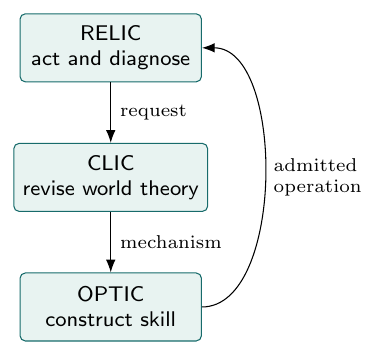
- Feedback \(A^{\circlearrowleft }\).
An admitted or rejected downstream result returns to an upstream workflow as new evidence. The loop has a stopping rule, budget, and version discipline.
These constructors describe workflow syntax. They do not yet prove that creative workflows form a PROP, operad, double category, or another stronger categorical structure. Such a claim requires explicit objects, morphisms, equivalences, and coherence laws. The finite sketch is deliberately weaker: it lets experiments reveal which equations and universal constructions are actually stable.
Component admission does not compose automatically. Even if two packets are individually admitted, their sequential composite is admitted only when an interface observer verifies type compatibility, uncertainty transport, version alignment, and the claimed joint consequence on independent evidence. Overall workflow admission is therefore a separate judgment, not the conjunction of component statuses.