ifc-0221
16.4 Double involution in an executable world
The two DIAL directions have a direct operational meaning. Assimilation keeps \(\mathbb S\), \(\mathcal E\), and \(R\) fixed while estimating parameters, calibrating stochastic mechanisms, or improving predictions. For a parameterized simulator \(\Phi _\theta \), local probes may take the form
Proto-accommodation probes changes to the maintained simulator package. A candidate whose theory presentation or executable schema changes may contain maps \(J\) and \(K\):
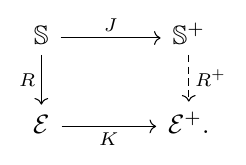
The candidate package change may introduce a latent state, observable, mechanism, intervention surface, or composition law. It is a theory extension only when the presentation or generative language changes. Admission asks whether \(R^{+}\) exists, whether old evidence transports conservatively, and whether new predictions survive held-out execution; only then is the package change installed as accommodation. In the strict presentation-level case the square must commute. In a lax realization, the dossier instead contains a registered comparison
and tests its coherence and observational meaning; the dashed arrow alone is not a transport certificate.
Mixed probes compare estimating or intervening before a package change with doing so afterward. Persistent disagreement is the simulator-facing shadow of the DIAL interchange obstruction. In a smooth chart it may be represented by a mixed bracket or curvature term. Crossing to a new ontology is nevertheless a finite sketch extension, not a Lie bracket merely because local probes helped discover it.