ifc-0276
18.10 Lexical calibration and typed realization
ARTISTIC-TI–0 first supplied an infrastructure positive control: the official textual-inversion loop trained, serialized, reloaded, and replayed a nonce embedding in a fresh process. Its substantive Stable Diffusion 1.5 run was not admitted. Four learned vectors produced partial in-domain binding, but the registered natural-language paraphrase was stronger and the learned token failed the background- and style-transport thresholds. The result is therefore evidence that lexical training was executable, not that concept naming or a new visual grammar had succeeded. The initial two-direction realization likewise failed all four preregistered clauses: a learned vector and selective replay were not enough to make the relevant structure explicit.
Typed realization replaces holistic visual similarity with an explicit declaration. The synthetic artifact is represented by a body, annulus, fins, their incidence, and a protected exterior. ARTISTIC-TI–2 showed that no fixed img2img strength simultaneously preserved the declaration and produced the requested exterior change. Adaptive admission selected the first strength satisfying the structural contract for each cell. TI-2C was the first admitted result; TI-2D repeated that contract satisfaction on textured images rather than only clean controls.
The remaining question is where a failed cell should be repaired. TI-3, TI-3B, and TI-3C compare latent exterior masking, explicit scalar retraction, and componentwise retraction; each exposes a more localized obstruction. TI-3D restores the admitted parent only on typed precision and recall counter-witness sets. All 24 cells required halo width zero: the witness pixels themselves were sufficient.
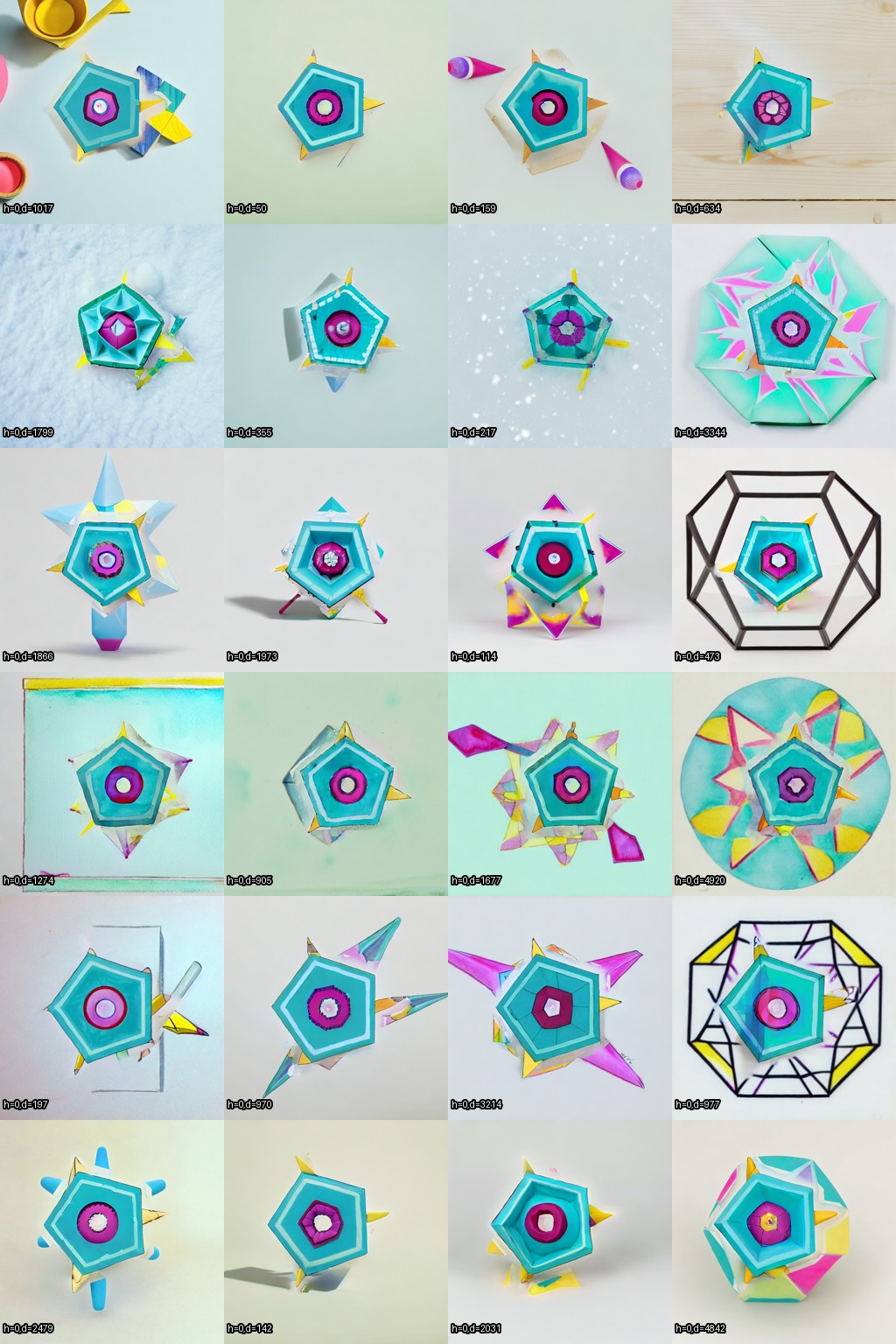
The admitted TI-3D repair achieved structural score \(0.820\), a \(100\% \) strict-contract rate, and prompt similarity \(0.362\). Its minimal object core occupied \(12.97\% \) of the image and added counter-witness repair only \(0.55\% \). Total retraction area was \(70.43\% \) of a registered blanket alternative, below the frozen \(75\% \) ceiling. The benefit was not merely that projection worked; the obstruction localized where projection was needed.