ifc-0306
19.13 Registered paintbrush evidence
The paintbrush experiments form a preregistered DILATE diagnostic sequence. Their archived artifacts retain the earlier DIAL-CAN–PB identifiers, while this chapter reports them as evidence about DILATE. A failed stage is retained because each failure identifies structure required by a stronger model.
|
Stage |
Admission |
Change in the hypothesis class |
Principal result |
|---|---|---|---|
|
PB0 |
Fail |
Select one member of a finite trajectory-operator grammar |
Residual reduction \(0.682\), just below the frozen \(0.70\) gate |
|
PB0.1 |
Pass |
Fit continuous parameters inside the declared family |
Residual reduction \(0.991\); witness correlation \(1.000\); endpoint error \(0.010\) |
|
PB1 |
Pass |
Select the missing operator family from a typed grammar |
Selected edge-energy gated band-pass; residual reduction \(0.976\); all 14 gates passed |
|
PB2 |
Fail |
Synthesize a composite technique from a verbal artistic intent |
Generalization failed: held-out composite/atomic ratio \(1.581\) and semantic retention \(0.872\) |
|
PB2.1 |
Fail |
Normalize total action over the denoising path |
Held-out ratio improved to \(0.846\), but semantic retention was \(0.948\) and focal response remained unstable across prompts and step counts |
|
PB2.2 |
Pass |
Add observer metric, state-adaptive transport, and rendered action calibration |
All 15 gates passed; contract objective fell from \(4.051\) to \(0.239\) |
PB0.1 establishes controlled recovery of one withheld member of a declared operator family. PB1 goes one level higher: without access to that family or its fitted parameters, it searched a finite typed observer-field grammar and selected an edge-energy-gated band-pass skeleton. Its winning objective was \(0.0153\), compared with \(0.3991\) for the second candidate, and the shuffled screening control never exceeded cosine \(0.0063\). This is family proposal inside a declared grammar, not invention outside it.
PB2 removes the oracle target and begins from an artistic brief. Its failure is instructive. Applying a plausible composite at each denoising step accumulated too much effect, and merely normalizing the path in PB2.1 did not make a fixed brush act consistently across local SDE states. PB2.2 repaired that defect by transporting the requested observer response through the local metric and by selecting total action from rendered recovery cases before the held-out set was generated.
On four held-out prompts, PB2.2 produced focal-detail ratios
a median peripheral-detail ratio of \(0.776\), CLIP semantic retention of \(0.988\), and median registered connection-response residual \(0.0013\). No connection evaluation activated the safety norm cap. Across 16-, 24-, and 32-step samplers, the maximum focal-effect and peripheral-effect ranges were \(0.0535\) and \(0.0633\), respectively.
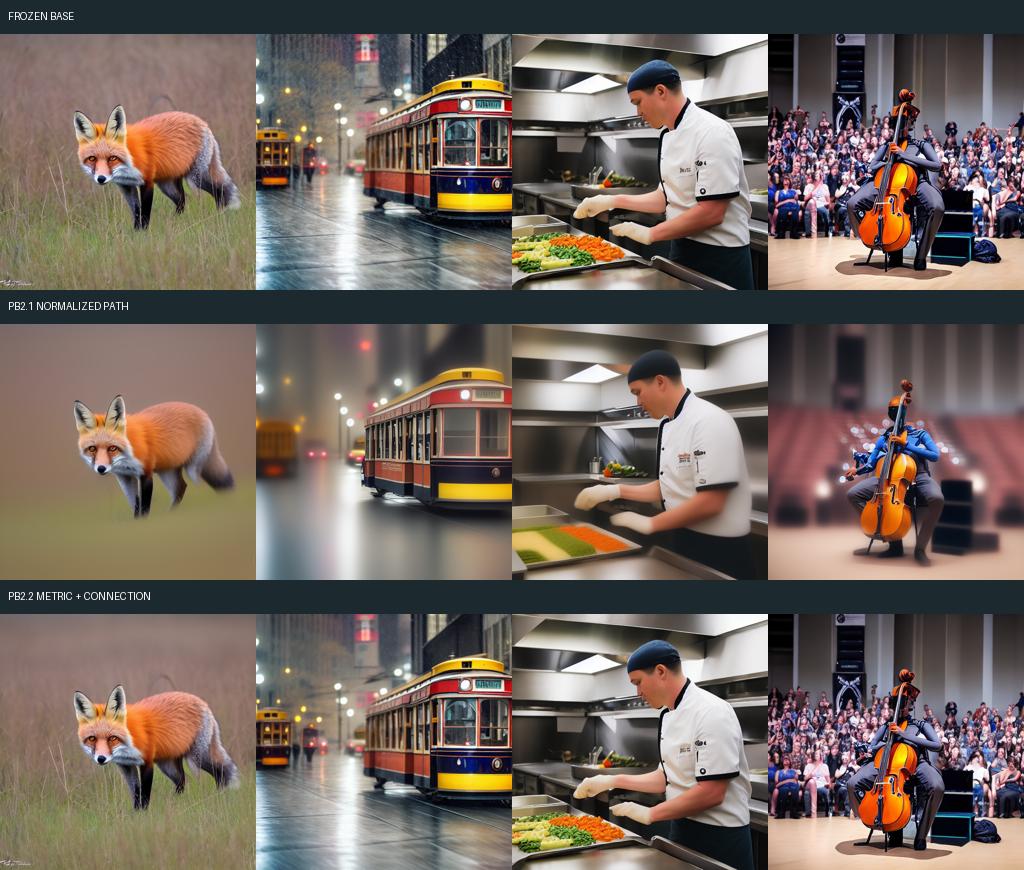
Experiment: DILATE–2.2: Connected Paintbrush. Artifact. A reusable trajectory technique in a finite typed program language.
Experimental provenance. Archived as DIAL-CAN–PB2.2.
Frozen intent. Preserve focal detail while progressively softening the transition and peripheral regions.
Geometry. Observer-response pullback form, regularized weighted-response lift, normalized path action, and state-adaptive connection-like transport.
Controls. Atomic programs, null and shuffled cases, strength monotonicity, semantic and color preservation, prompt transport, and 16/24/32-step discretization.
Outcome. All 15 preregistered admission gates passed.
Claim boundary. The result supports a local empirical paintbrush geometry in a fixed observer chart. It does not establish a global Lie algebroid, integration to a Lie groupoid, open-ended style invention, or human artistic value.
The progression matters more than the final score. PB0–PB1 move from parameter recovery to typed family selection. PB2–PB2.2 move from oracle recovery to an intent-conditioned technique assembled inside a supplied finite program language, and show why normalization, a fiber metric, a state-adaptive transport rule, and image-level calibration are not optional details. The creative threshold beyond these studies remains unresolved and is not another gain on the same contract. It is the construction and admission of a generator that the original typed grammar did not contain.