ora-0010
0.7 Three worlds, one learner
The three examples are not isolated modules. Imagine that a caregiver says, “Give me the blue cup.” The episode recruits language to identify an action and its argument, core object and form systems to locate the referent, spatial and motor organization to reach and grasp it, and social knowledge to interpret the utterance as a request. Success depends on composites that cross the boundaries between learned worlds.
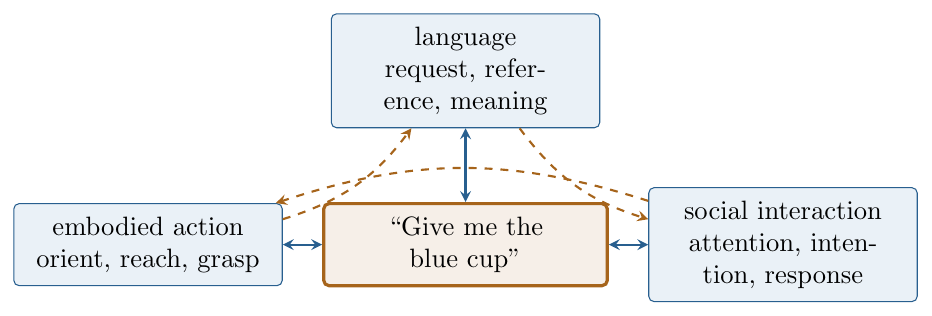
This intersection exposes why an inventory of separate task solvers is not a theory of development. The child must retain enough typing to know which linguistic construction selects which object, which social relation licenses which response, and which motor transformation realizes it. Conversely, action supplies evidence that can repair language or social interpretation: the caregiver’s correction may reveal that the wrong cup was selected, not that grasping has failed.
The example also suggests a criterion for lifelong utility. A construction earns persistence when it participates reliably in many composites across contexts and domains. Such a construction is valuable not because it solved one benchmark, but because it becomes part of the learner’s reusable account of its world.