sec-particle-physics-discovered-world
0.8 Particle physics as a discovered world
Developmental learning is not the only process that discovers compositional worlds from interaction. Science does so collectively and over much longer timescales. Particle physics supplies an unusually clear example because its objects are known through the transformations, collisions, and detector responses in which they participate.
At the kinematic level, relativistic elementary particle types are classified by irreducible positive-energy unitary representations of the Poincaré group (more precisely, of the appropriate covering group), with mass and spin or helicity emerging as representation-theoretic invariants [ Wigner , 1939 ] . The Standard Model adds much more than this classification. Its internal gauge structure, matter representations, symmetry breaking, and interaction terms form an algebraically presented compositional theory. The gauge-theoretic line begins with Yang–Mills theory and includes the electroweak synthesis exemplified by Weinberg’s lepton model [ Yang and Mills , 1954 , Weinberg , 1967 ] . Tensor products and their decompositions constrain composite systems and possible channels; interaction vertices generate processes; conservation and gauge laws impose relations among them.
In this broad categorical sense, the Standard Model is not a catalogue of every possible physical state. It is a compact theory that generates allowed processes and predicts their observable consequences. This is the same pair of compression principles introduced in Section 0.3.1: LEGO illustrates generation from reusable operations, while diversity representations illustrate identification through a compact family of separating experiments. Particle physics combines both at the scale of a mature physical science.
An accelerator can accordingly be viewed as a restricted physical Yoneda instrument. Let \(\mathcal H\) be a category of candidate physical theories and \(\mathcal P\) a category of experimentally realizable beam preparations, energies, collision channels, and detector configurations, with its morphisms encoding refinement and restriction of probes. A candidate \(H\) induces a response functor
assigning to each probe a law over detector outcomes. By varying probes, physicists construct a response profile of \(H\). The Yoneda analogy is that an object is characterized relationally by how every admissible probe maps into, acts on, or responds to it.
The qualification restricted is essential. The Yoneda lemma assumes all morphisms from all objects and exact access to their action. A collider offers only physically constructible probes, finite noisy samples, bounded energy, and detector-mediated observations. Moreover, Equation 0.1 is a statistical response functor, not automatically a representable hom-functor. Two theories with equivalent responses on \(\mathcal P\) are experimentally indistinguishable under the current doctrine even if a richer probe category could separate them.
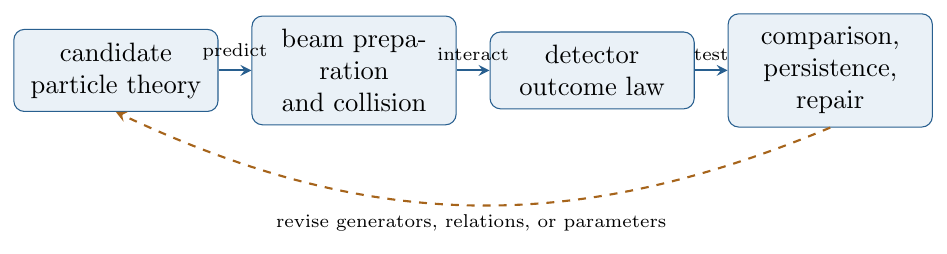
This example also clarifies scientific assimilation and accommodation. A new measurement can refine masses, couplings, or background models inside an accepted theory. A stable unexplained response may instead demand a new particle type, interaction generator, symmetry, or relation. Responsible repair is localized: detector calibration and nuisance models are tested before the entire particle ontology is replaced. Science advances by growing and revising a generative theory under increasingly separating interactions, not by storing the state of the universe.
The categorical analogue of scientific understanding is not exhaustive state reconstruction. It is a compact generative theory together with a sufficiently separating, explicitly delimited family of experimental response functors.