ora-0054
3.9 The fragment cover of the core sketch
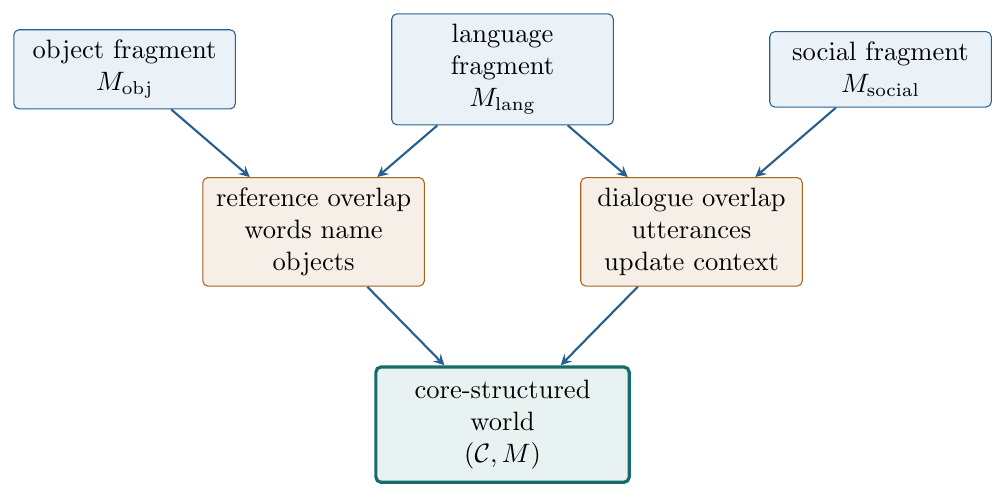
Let \(I\) index the six core fragments and choose subsketches
whose union generates \(\mathbb T_{\mathrm{core}}\). Pairwise and higher intersections \(\mathbb T_{i_0\cdots i_k}\) encode the warrants joining the fragments. For a core-structured world \((\mathcal C,M)\), restriction gives local realizations
The resulting Čech-shaped diagram is the learner’s decomposition of the world into initially probeable systems.
Two core-structured worlds are fragmentwise equivalent for a family of observers \((P_i)_{i\in I}\) when every \(P_iM_i\) is equivalent and the equivalences agree on all exposed overlaps. They are core-equivalent when the induced structured models of \(\mathbb T_{\mathrm{core}}\) are equivalent.
The distinction isolates a fundamental ORACLE risk. Local success can coexist with global error. A learner might track objects, infer goals, and segment utterances correctly while incorrectly gluing a name to an object or an utterance to an intention.