sec-reading-derived-continuity
1.17 Reading the derived skeletal-continuity theorem
The later finite-consistency theorem compares incremental and all-at-once homotopy-coherent UDL. Its comparison has the form
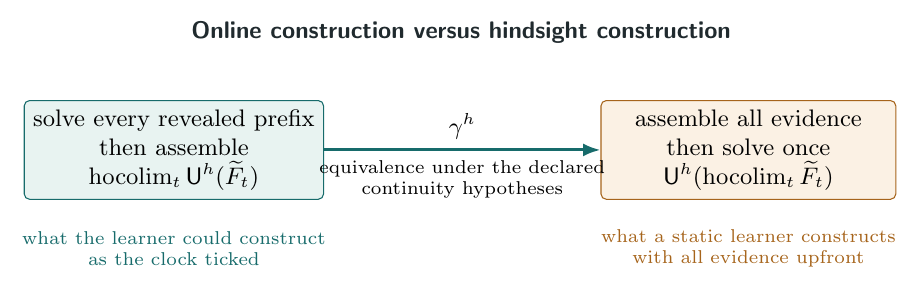
Each symbol now has a declared role:
\(\widetilde F_t\) is the evidence available at finite stage \(t\), extended to a common diagram domain.
The homotopy colimit retains the progressively assembled evidence up to semantic weak equivalence.
\(\operatorname {Lan}^h_J\) generates candidates and preserves the filtered homotopy colimit because it is a left adjoint.
\(\operatorname {Ran}^h_K\) enforces consistency through pointwise homotopy limits.
Finite consistency shapes and a stable target allow the filtered colimit to commute with those finite limits.
Under these hypotheses, \(\gamma ^h\) is an equivalence.
A claimed derived online-to-offline theorem must identify the weak equivalences, the localization, the common diagram domain, the existence of both derived Kan extensions, the pointwise right-Kan limit shapes, and the exact colimit–limit interchange being used. Without these declarations, the superscript \(h\) is only suggestive notation.