ora-0030
1.16.1 Infinitesimal decision classes
1.16.1 Infinitesimal decision classes
Witsenhausen’s classification separates two logically independent questions. The first asks whether the decision sites cooperate or compete; the second asks how information can flow among them. Tangent lifting should preserve this separation. A problem does not become a game merely because its information structure is nonclassical, and a team need not have classical information.
On the objective axis, an intrinsic model is a team problem when all decision sites share a single objective \(J:\Omega \times \prod _{\alpha }U_\alpha \to \mathbb R\). An infinitesimal team problem carries one tangent objective \(TJ\), so an admissible variation is evaluated by the same first variation \(\dot J\) at every site. A game problem instead partitions the sites among players \(p\in P\) and supplies player-indexed objectives \(J_p\). Its infinitesimal variant carries the family \((TJ_p)_{p\in P}\). Thus the tangent of a team optimality condition is a common first-order optimality condition, whereas the tangent of a game solution concept is a coupled system of playerwise conditions. In particular, linearizing a Nash equilibrium is not the same operation as differentiating a common team optimum.
On the information axis, write \(\beta \leadsto \alpha \) when the action at \(\beta \) is permitted to affect the observation at \(\alpha \). The following fixed-stratum variants mirror the usual intrinsic-model classes [ Witsenhausen , 1971 , 1975 ] .
- Infinitesimal static.
Every \(y_\alpha \) factors through the projection \(H\to \Omega \). No decision can change any decision site’s information, and hence \(D_u y_\alpha =0\).
- Infinitesimal sequential.
There is an ordering \((\alpha _1,\ldots ,\alpha _N)\) such that \(y_{\alpha _k}\) factors through \(\Omega \times \prod _{j{\lt}k}U_{\alpha _j}\). Its tangent equations can therefore be solved in that order.
- Infinitesimal classical.
The model is sequential and its information fields are nested along a witnessing order: \(\mathcal I_{\alpha _k}\subseteq \mathcal I_{\alpha _{k+1}}\). In a smooth presentation we record this nesting by comparison maps \(r_k:Y_{\alpha _{k+1}}\to Y_{\alpha _k}\) satisfying \(y_{\alpha _k}=r_k y_{\alpha _{k+1}}\). Tangent nesting is the identity \(Ty_{\alpha _k}=Tr_k\, Ty_{\alpha _{k+1}}\).
- Infinitesimal strictly classical.
In addition, the next site observes the preceding action: the joint map \((y_{\alpha _k},u_{\alpha _k})\) factors through \(y_{\alpha _{k+1}}\). Its tangent lift carries both \(Ty_{\alpha _k}\) and \(Tu_{\alpha _k}\) forward.
- Infinitesimal partially nested.
This is Witsenhausen’s quasiclassical case: the model is sequential and every structural influence \(\beta \leadsto \alpha \) is accompanied by information inclusion \(\mathcal I_\beta \subseteq \mathcal I_\alpha \). Smooth comparison maps present these inclusions and their tangent lifts preserve them. In the strict version, \(\alpha \) also observes the action \(u_\beta \).
- Infinitesimal nonclassical.
The model is sequential but has a signaling edge \(\beta \leadsto \alpha \) for which the required upstream information is not available at \(\alpha \). The tangent system retains this information defect: a perturbation can propagate through \(u_\beta \), although the downstream decision mechanism cannot condition on all information that generated it.
- Infinitesimal nonsequential.
No fixed global order witnesses causal execution. A tangent response, when one exists, must be obtained from the coupled equation rather than from causal forward substitution.
These names describe structural strata, not properties of a single Jacobian. For example, an allowed influence edge remains part of the declaration even when its derivative happens to vanish at one base point. Conversely, a first-order perturbation may vary a permitted channel but may not silently add a new one.
Crossword solving will provide a running instance of these distinctions in 9.15. Each clue is a decision site, crossing letters are information channels, and all sites share the objective of completing one grid. Perturbing the confidence assigned to candidate words stays within a fixed information stratum. Adding a candidate answer, fixing a new crossing, or changing the clue-incidence graph changes the declared combinatorial structure and therefore calls for repair rather than an ordinary tangent update.
Let \(\widetilde{\mathcal M}:\mathbb D_W\to \mathfrak {Intr}_{\mathrm{sm}}\) be fixed-stratum. If \(\mathcal M\) is a team, game, static, sequential, classical, strictly classical, quasiclassical, strictly quasiclassical, nonclassical, or nonsequential intrinsic model, then its tangent lift has the corresponding infinitesimal type. Changing membership in one of these structural classes requires a change of stratum rather than an ordinary tangent vector.
The fixed-stratum declaration preserves the player partition, the number and indexing of objectives, the influence and precedence relations, and the factorization maps presenting information inclusion. Weil prolongation is functorial: it preserves identities and compositions. It therefore carries each recorded factorization \(y_\beta =r_{\beta \alpha }y_\alpha \) to \(Ty_\beta =Tr_{\beta \alpha }\, Ty_\alpha \), while retaining the same witnessing order and objective indexing. Each defining structural predicate is thus preserved. Altering one of those witnesses changes the declaration itself.
The taxonomy sharpens the solvability calculation below. In the static case \(L_{\mathcal M}=0\), so local variations do not circulate through other decisions and \(\dot u=b_{\mathrm{ev}}+b_{\mathrm{act}}\). In the sequential case, \(L_{\mathcal M}\) is nilpotent after reordering. Classical and partially nested systems add information-preservation constraints to that triangular propagation. A nonclassical system may still be triangular and uniquely solvable, but its variations expose signaling without the corresponding inheritance of upstream information—the infinitesimal trace of the nonclassical information pattern.
For a first-order probe, assemble the intrinsic equations into
At a base solution, differentiation gives
Here \(b_{\mathrm{ev}}\) collects variation of exogenous evidence and the observation maps, whereas \(b_{\mathrm{act}}\) collects variation of the decision mechanisms. Thus the intrinsic model gives a concrete realization of the LINCS separation between varying what an agent knows and varying how the agent acts on what it knows.
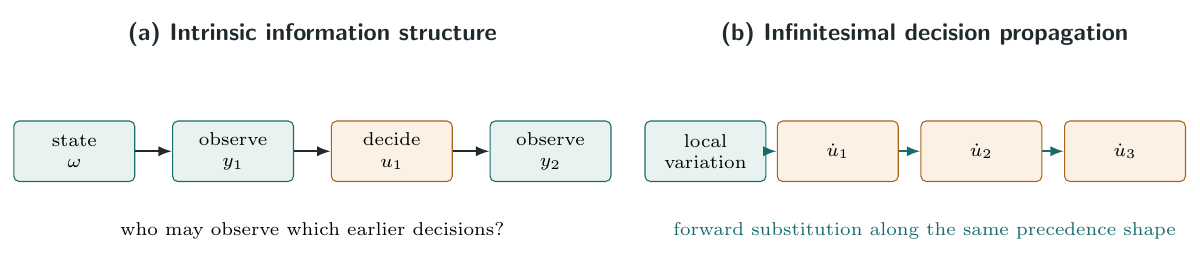
Let \(A=\{ \alpha _1,\ldots ,\alpha _N\} \) be finite. Suppose the exogenous-state, action, and observation spaces are finite-dimensional smooth spaces near a closed-loop solution, and every \(y_\alpha \) and \(\pi _\alpha \) is continuously differentiable there. Assume the fixed information-dependency relation admits the displayed ordering, with \(y_{\alpha _k}\) depending only on \(\omega \) and decisions \(u_{\alpha _j}\) for \(j{\lt}k\). Then \(L_{\mathcal M}\) is strictly block lower triangular, so
Consequently, every admissible pair \((b_{\mathrm{ev}},b_{\mathrm{act}})\) determines a unique infinitesimal closed-loop response \(\dot u\), computable in causal order by forward substitution.
If \(j\geq k\), the stated information restriction makes the block derivative \(D_{u_{\alpha _j}}\Phi _{\mathcal M,\alpha _k}\) zero. Hence \(L_{\mathcal M}\) is strictly block lower triangular in the chosen order. Every such \(N\)-block matrix is nilpotent of degree at most \(N\), and the finite geometric sum displayed above is a two-sided inverse of \(I-L_{\mathcal M}\). Applying that inverse to 1.1 gives existence and uniqueness. Its triangular form is exactly forward substitution through the decision events.
This theorem is the infinitesimal shadow of causal implementability. In a cyclic intrinsic model, the corresponding local criterion is invertibility of \(I-L_{\mathcal M}\). Failure of invertibility records an infinitesimal solvability obstruction: a perturbation may be underdetermined, inconsistent, or poised at a bifurcation.
To connect the construction to UDL, let \(F_{\mathcal M}\) encode the local laws compatible with the declared information fields, and let the right Kan stage encode their closed-loop compatibility. The canonical map
then compares solving before linearization with assembling the tangent-local laws. Under the fixed-shape preservation hypotheses for tangent Kan extension, the two routes agree. Witsenhausen’s information structure supplies the causal interpretation that categorical universality alone does not provide.
The nerve supplies the temporal reading. A causal ordering of decision events determines a simplex in the decision nerve; its faces are shorter executable prefixes. The infinitesimal intrinsic model decorates that same simplex with tangent evidence and action maps. Coherent tangent transport therefore asks that these decorations restrict and compose along every face.
An infinitesimal intrinsic model does not add or delete an information edge, refine or coarsen an information field, split a decision maker, or change a causal precedence relation. These operations move between structural strata and require a registered LINCS repair. Likewise, singularity of \(I-L_{\mathcal M}\) diagnoses local solvability failure; by itself it does not identify an intervention or a causal effect.