ifc-0006
0.3 Diagrams and compositional promises
A directed graph records generating objects and arrows. Its path category adds identities and every finite composite. A diagram of shape \(J\) in \(\mathcal C\) is a functor \(D:J\to \mathcal C\); informally, \(J\) is a wiring pattern and \(D\) supplies an interpretation of that pattern.
Two paths are parallel when they have the same source and target. A square
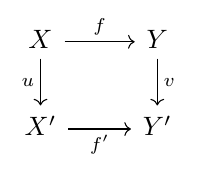
commutes when
The equation can express preservation under a change of coordinates, agreement between two calculations, compatibility of local descriptions, or transport of an experiment between models. The diagram says which routes are promised to agree. A model can fail that promise.
Relative to a declared diagram, a compositional obstruction is the typed failure of two required parallel routes to agree, of a required factorization to exist, or of a designated universal property to be realized. An observer may turn the obstruction into vector-, relation-, distribution-, language-, or scalar-valued evidence, but that evidence is not the obstruction’s type-independent definition.
This distinction is central. The equation \(\lVert v f-f'u\rVert ^2\) is meaningful only after the codomain has enough linear or metric structure. The commutative square is meaningful in any category. Synthetic creativity begins with the structural promise and then chooses observers suited to the application.
This also marks the progression across the three books. Diagrammatic Backpropagation in Categories for AGI introduced diagrammatic curvature as an optimizable scalar penalty. LINCS subsequently separated the typed obstruction from any chosen scalarization. The present book inherits that separation and asks the additional question of when persistent evidence warrants a finite extension of the declaration itself [ Mahadevan , 2026b , 2026e ] .