ifc-0007
0.4 Functors and natural transformations
A functor \(F:\mathcal C\to \mathcal D\) assigns objects to objects and morphisms to morphisms while preserving identities and composition:
A functor is therefore a compositional translation. Cartesian coordinates can be viewed schematically in this spirit: geometric constructions receive algebraic representations, and a sequence of constructions must correspond to the associated sequence of algebraic operations. Establishing a literal functor requires specifying the source and target categories; the historical analogy alone does not do that work.
Functors also separate a formal theory from a realization. A schema or sketch specifies roles and legal routes; a functor interprets them as sets, smooth spaces, programs, database tables, or simulator components. The same theory can therefore have many models.
Given functors \(F,G:\mathcal C\to \mathcal D\), a natural transformation \(\eta :F\Rightarrow G\) assigns a map \(\eta _X:F(X)\to G(X)\) to every object so that for each \(f:X\to Y\),
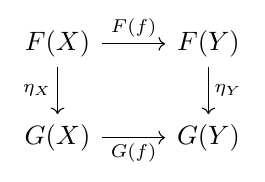
commutes.
Naturality says that a family of local changes is coherent with the structure connecting its components. This is one model of a compositional repair. A system whose modules are independently modified may improve local scores while destroying the routes that gave those modules meaning.
. A metaphorical correspondence between two fields is not automatically a functor, and a family of edits is not automatically a natural transformation. The objects, maps, and preservation equations must be stated before those terms carry mathematical force.