ifc-0008
0.5 Universal constructions: defining by relations
Many important objects are characterized not by an implementation but by how all other objects map to or from them. Such a universal property specifies a construction up to canonical isomorphism.
A product \(X\times Y\) supports paired observations. Given maps \(f:Z\to X\) and \(g:Z\to Y\), there is a unique pairing \(\langle f,g\rangle :Z\to X\times Y\) with the expected projections. A pullback
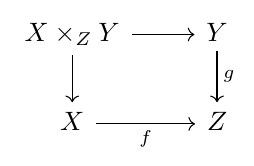
represents pairs that agree over a shared target. A pushout reverses this pattern and glues objects along a common interface.
These constructions already have creative readings:
- Product.
Place several probes or descriptions in a common context.
- Pullback.
Discover which candidates satisfy two compatible views.
- Pushout.
Combine theories or modules through a registered interface.
- Equalizer.
Identify the locus on which parallel accounts agree.
- Coequalizer.
Quotient distinctions declared irrelevant or redundant.
An optimizer may approximate one of these constructions, but low loss does not state its universal property. The declaration and its numerical observer remain different levels.