ifc-0034
2.3 Two interacting classes of repair
Piaget’s distinction suggests more than two labels for updates. It suggests two processes whose interaction is itself informative. The double repair package introduced in Chapter 0 assigns repairs expressible inside the current declaration to the assimilatory side \(A_{\mathrm{asm}}\), and local probes of a possible reorganization to the proto-accommodative side \(B_{\mathrm{acc}}\). Those probes test how a schema might have to change; they are not yet the finite change.
The interaction is represented internally by the proposed interchange defect \(\Theta _{\mathrm{int}}\) and, when a classical cochain realization is supplied, by \(\Omega _{\mathrm{cre}}\). Either object localizes an incompatibility only relative to a declared observer. It does not determine a replacement theory or certify a creative frontier. Chapter 3 constructs the formal target, distinguishes the established classical criterion from the proposed tangent-categorical bridge, and states the realization requirement precisely.
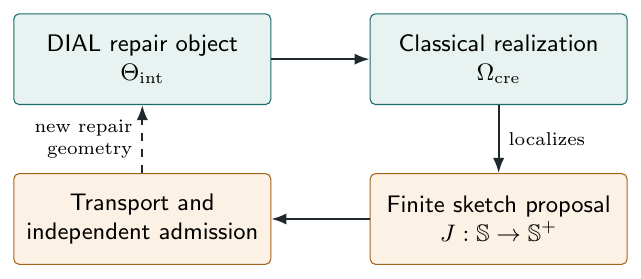
This architecture deliberately leaves an abductive gap. The obstruction \(\Theta _{\mathrm{int}}\), or its realized observer \(\Omega _{\mathrm{cre}}\), does not determine a unique \(\mathbb S^+\). A frontier model, program synthesizer, scientist, or other proposal engine must construct candidate extensions. Finite sketches then make those candidates explicit enough to compare, transport, and test. Thus DIAL supplies the typed diagnosis, its classical double-Lie realization supplies a computable observer, and sketch surgery supplies the global proposal.