ifc-0278
18.12 Transfer to natural photographs
Natural-image transfer uses two evidence regimes. NI-0 uses independently annotated pet photographs and passes six of seven clauses, but fails its area criterion because total protected area was dominated by the mandatory subject. NI-1 preregistered the decision-relevant marginal statistic
On six previously unseen Oxford-IIIT Pet subjects and eighteen generated cells, all seven clauses passed. Against sealed human trimaps, localized repair raised structural score from \(0.557\) to \(0.642\), reduced subject-region RGB error from \(0.0459\) to \(0.0020\), and used about one third less added area than blanket repair.
NI-2 replaces the single foreground object by typed relational diagrams. Each COCO scene supplied person instances, grouped articulated parts, part–whole incidence, identity order, centroid geometry, and relative visible area. Public declarations were produced by frozen Mask R-CNN and Keypoint R-CNN observers; COCO polygons and keypoints remained sealed until generation and repair were complete.
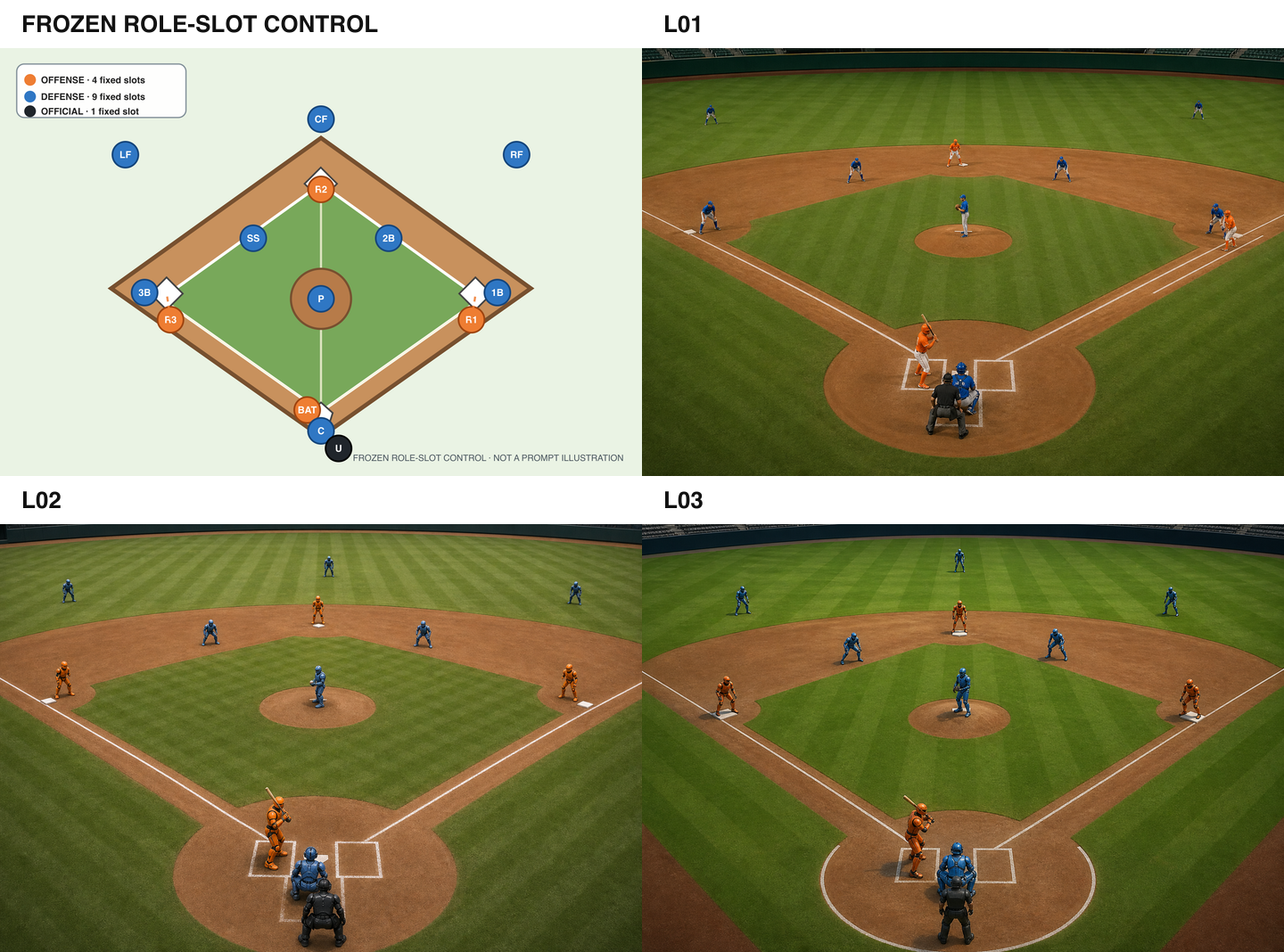
A robot-baseball role testbed illustrates the declaration principle. A finite role sketch specifies four offensive players, nine defenders, and one official before image realization. Unlike a verbal prompt, the diagram makes cardinality, role, and location constraints explicit and provides a common interface for generation and audit.
NI-2A passed all ten clauses as a two-person calibration: declaration mask IoU was \(0.867\), human-keypoint PCK \(0.984\), and all twelve repaired cells preserved pair geometry. Its metric conventions were completed after public outputs existed but before annotation scoring, so a confirmatory claim was reserved for a fresh cohort.
NI-2B froze the complete contract in advance and introduced three people, partial poses, and occlusion. Eight of eleven clauses passed. Identity order was preserved in every cell and articulation remained strong, but relative visible-area relations failed. The experiment rejected the assumption that an observer’s point estimate remains reliable when a person is truncated, occluded, or embedded in a crowd.