ifc-0279
18.13 Intervals, abstention, and active acquisition
NI-2C changed the type of the relation rather than weakening its threshold. If person \(i\) has \(k_i\) confident keypoints, its public log-area uncertainty is
For reference person \(0\), the relative log-area interval is
A categorical claim is emitted only when the entire interval lies beyond the registered indifference band: \(\inf I_{i0}{\gt}0.15\) certifies larger, \(\sup I_{i0}{\lt}-0.15\) certifies smaller, and every other case abstains.
This repaired calibration: all eight sealed annotation-derived ratios and all twenty-four output ratios lay in their intervals, and no certified claim was false. But only one of eight comparisons was certified. NI-2C therefore passed twelve of thirteen clauses and failed the frozen \(25\% \) claim-coverage requirement. Reliable ignorance was preferable to false precision, but was not yet useful enough.
|
Interval relation |
Emitted claim |
Epistemic reading |
Permitted action |
|---|---|---|---|
|
\(\inf I_{i0}{\gt}0.15\) |
person \(i\) is larger |
The complete uncertainty interval clears the indifference band. |
Preserve the certified ordering through repair. |
|
\(\sup I_{i0}{\lt}-0.15\) |
person \(i\) is smaller |
The complete uncertainty interval clears the band in the opposite direction. |
Preserve the certified ordering through repair. |
|
\(I_{i0}\cap [-0.15,0.15]\ne \varnothing \) |
abstain |
Available evidence does not determine a stable categorical relation. |
Acquire another registered view or leave the relation unspecified. |
NI-2D made acquisition conditional on that ignorance. When a base interval abstained, the observer acquired a horizontally reflected view, inverse-mapped its person masks, and tested agreement in the original coordinates. An interval narrowed only when both relevant masks had IoU at least \(0.70\) across views and absolute log-area change at most \(0.15\). The fused radius used the preregistered sharper rule
Disagreement left the original interval untouched. The second view is a registered equivariance probe of the same frozen segmenter, not an independent semantic observer.
|
Stage |
Admission |
Annotation coverage |
Claim precision |
Claim coverage |
|---|---|---|---|---|
|
NI–2B: point relation |
8/11 clauses |
not represented |
brittle |
incomplete |
|
NI–2C: interval and abstention |
12/13 clauses |
\(100\% \) |
\(100\% \) |
\(12.5\% \) |
|
NI–2D: active second view |
13/13 clauses |
\(100\% \) |
\(100\% \) |
\(25.0\% \) |
Seven of NI-2D’s eight base comparisons triggered acquisition. Five passed the agreement gate and were narrowed; two retained wide intervals because the reference-person observation was inconsistent. Mean half-width fell from \(0.9375\) in NI-2C to \(0.7550\), while sealed-annotation coverage remained \(100\% \). Certified coverage doubled to two of eight comparisons, with precision still \(100\% \). All thirteen preregistered clauses passed.
The same distinction between public observation and sealed structural audit can be made concrete in a robot-only testbed. In the robot-baseball example, each visible player is assigned a typed role and compared with the frozen role-slot declaration; the overlay exposes omissions, duplicates, and misplacements rather than scoring the scene as an undifferentiated image.
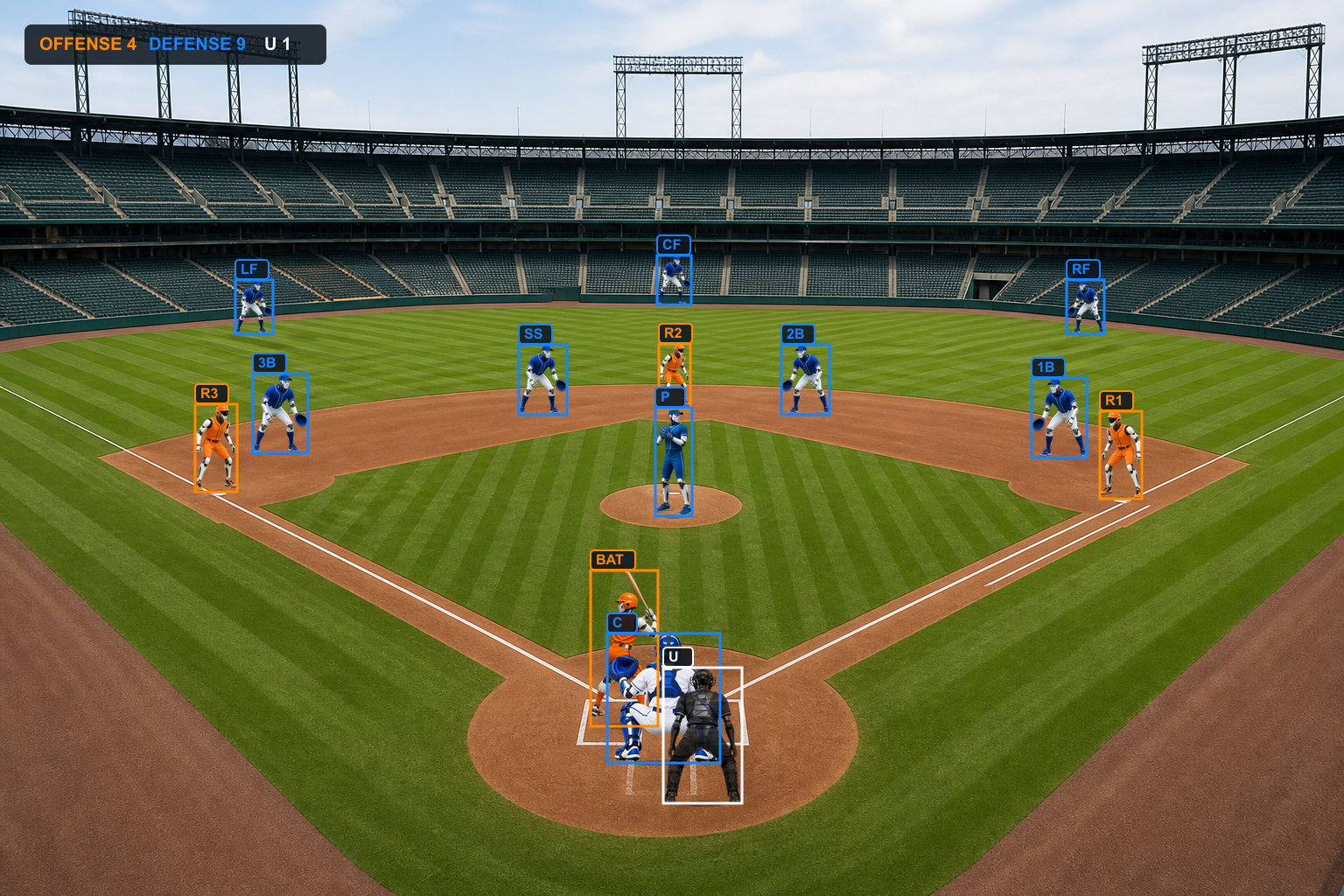
The generated-output audit was conjunctive. Before localized repair, instance IoU was \(0.787\), keypoint PCK \(0.975\), interval coverage \(91.7\% \), and structural score \(0.875\). After repair these became \(0.836\), \(0.997\), \(100\% \), and \(0.912\). Identity order and triangle geometry passed in all twelve cells. Subject RGB error fell from \(0.0633\) to \(0.00329\), and the incremental repair-area ratio was \(0.191\), below the frozen \(0.75\) ceiling.
A complementary pose experiment shows how such an audit becomes a localized repair. The first realization places the catcher in the wrong orientation; the second enforces the registered catcher pose; the third harmonizes that typed insertion with the surrounding image while preserving the other player roles and field layout.
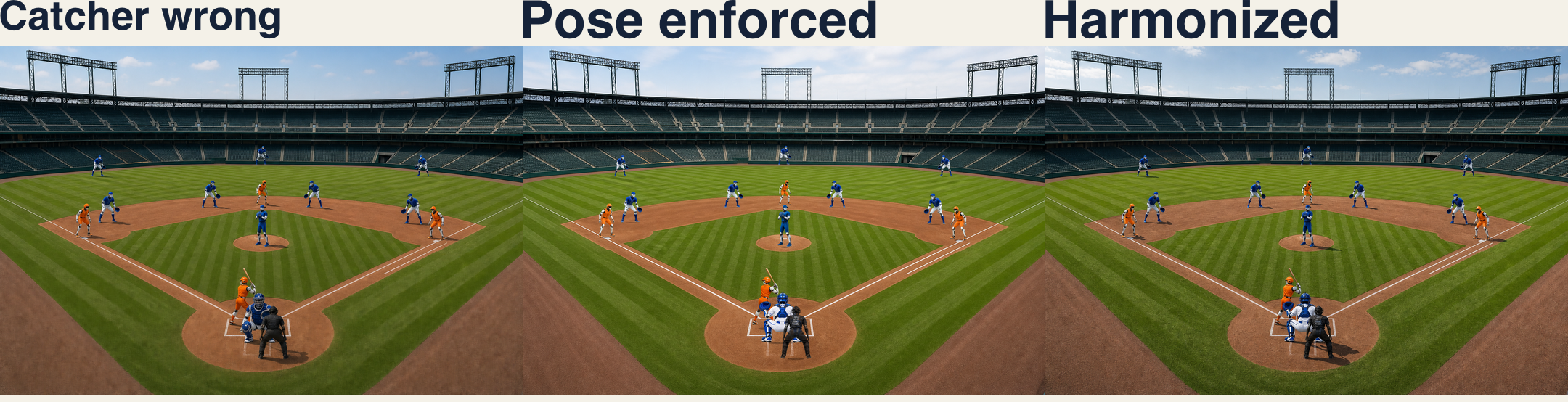
. Active observation is creative only in a restricted sense: the system changes what evidence it seeks to decide whether its declaration can be sharpened. The key result is not that another view always helps, but that agreement licenses refinement while disagreement preserves abstention.