ifc-0289
18.15.1 Five evidence regimes for concept induction
18.15.1 Five evidence regimes for concept induction
Five evidence regimes connect registered scene graphs to historical pixel problems. Their results are summarized below. The rows are not a leaderboard: Corpus–2 is a sealed blind evaluation, while Corpus–4 deliberately uses the published target relation as an oracle for active admission and is therefore an upper-bound experiment.
|
Stage |
Question |
Result |
Diagnostic |
|---|---|---|---|
|
Corpus–0 |
Can a registered scene-graph language grow conservatively? |
50/50 solved; 11 by reuse, 32 by composition, and 7 by accommodation; language size \(3\! \to \! 10\). |
Typed extensions were reusable and caused no regression on earlier problems. |
|
Corpus–1 |
What is missing on historical BP1–25? |
7 expressible; 7 required a rule constructor; 11 required a perceptual primitive. |
Rule search and perceptual representation are distinct obstructions. |
|
Corpus–2 |
Does a frozen scalar observer generalize blindly to BP26–50? |
16 rules admitted and 9 abstentions; after reveal, 0 exact, 2 related proxies, and 14 spurious separators. |
Zero error concealed nuisance exploitation; 12/16 rules used horizontal centroid. |
|
Corpus–3 |
Does typed accommodation repair that failure? |
4 rules admitted: 3 semantic, 1 spurious, and 21 abstentions. |
Object–attribute binding removed most page-position shortcuts; conservative ignorance replaced unsupported claims. |
|
Corpus–4 |
Can candidate-specific queries improve admission? |
6/25 semantic rules, 19 abstentions, 0 selected spurious rules, using 7 oracle queries. |
Active counter-witnesses rejected accidental alternatives, but the oracle prevents an autonomous-discovery claim. |
The failure of Corpus–2 is the most informative result in the sequence. Its scalar learner appeared successful before the answer key was opened: sixteen of twenty-five problems had a zero-error rule. Yet none expressed the intended invariant. Accommodation in Corpus–3 replaced aggregate statistics with typed objects and relations, added 48 translation and crop-jitter counter-witnesses for every admitted rule, and calibrated selection by an exact permutation family-wise test. Precision improved sharply, at the price of twenty-one honest abstentions.
Corpus–4 then treated abstention as a request for information. Rather than discard the previous observer, it formed a conservative atlas
combining connected-contour evidence with a topology chart for filled cores and holes. This is evidence transport across accommodation: a new chart may extend what can be seen without invalidating previously admitted observations. The resulting system recovered six intended rules with no selected spurious rule, although nineteen cases correctly remained outside the supported language.
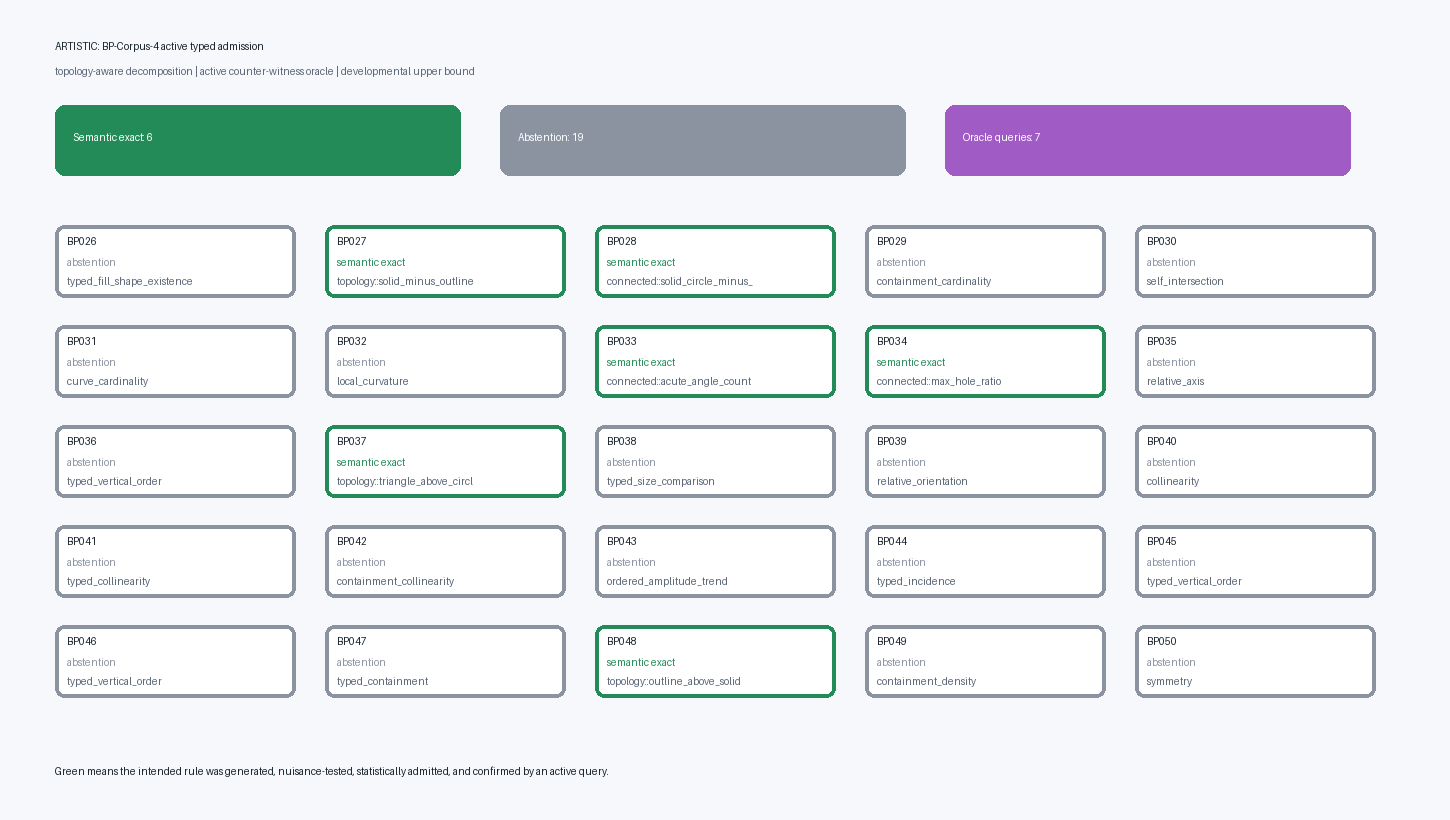
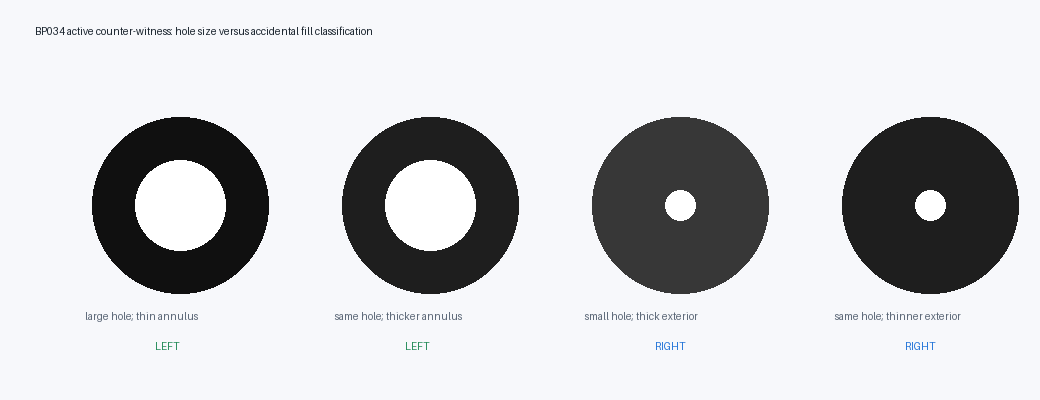
Problem 34 illustrates the active step. The displayed panels supported both an accidental fill-count rule and the intended distinction based on hole area. A synthesized counter-witness made those explanations disagree. The oracle rejected solid_minus_outline and admitted max_hole_ratio; the system changed which structural observable it trusted rather than merely tuning a decision threshold.
These experiments advance ARTISTIC from correcting a declared image defect to a bounded form of visual theory invention. The creative act is not drawing another panel; it is extending the vocabulary in which the distinction can be stated, transporting prior evidence into that extension, and admitting the new concept only after a discriminating probe.