ifc-0288
18.15 Visual theory invention in Bongard problems
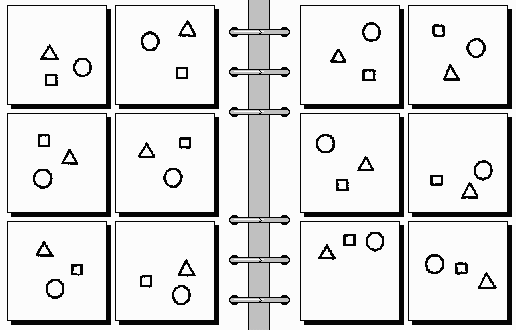
Bongard problems provide a sharper test of visual creativity than image repair. Each problem presents six positive and six negative drawings and asks for the intended rule that separates the two sides [ Bongard , 1970 , Foundalis , 2026 ] . The task is deliberately underspecified: twelve panels admit many accidental separators, whereas a successful explanation should name a reusable visual concept. Figure 18.10, for example, is not merely a binary classification problem. Its intended distinction is a relation between typed objects: a triangle lies above a circle on the left, while a circle lies above a triangle on the right.
This distinction turns Bongard solving into a compact experiment in theory construction. Let
be the current visual observer and let \(\mathcal H_k\) be its executable rule language. Assimilation searches for and composes hypotheses \(h\in \mathcal H_k\) while keeping \(O_k\) fixed. A candidate extension enlarges the declaration—for example by adding object identity, topology, containment, or a typed spatial relation—to obtain \((O_{k+1},\mathcal H_{k+1})\). It becomes an admitted accommodation only after counter-witness and transport tests. The mixed or core question is whether the new observable is bound to the right object and remains meaningful under irrelevant transformations. Thus zero panel error is only the beginning of admission, not its conclusion.
. A separating rule is not yet a discovered concept. Admission requires the rule to survive transformations that preserve the intended meaning and to fail on a counter-witness that reverses that meaning.
This point is familiar in earlier visual-language approaches to Bongard problems: a flexible classifier can fit incidental properties without recovering the concept communicated by the examples [ Depeweg et al. , 2018 ] . The DIAL formulation makes the remedy operational. For a candidate \(h\), the later stages used a conjunctive contract whose core conditions were
Here \(g\) ranges over registered nuisance transformations and \(q\) is an independent counter-witness. The final clause is especially important: a candidate-specific query can distinguish two rules that agree on all twelve displayed panels.