lin-0020
0.5 Natural transformations: coherent change
Functors describe structured systems. Natural transformations describe maps between such systems that are compatible with every arrow in the structure.
Given functors \(F,G:\mathcal C\to \mathcal D\), a natural transformation \(\eta :F\Rightarrow G\) assigns to every object \(X\) a morphism \(\eta _X:F(X)\to G(X)\) such that for every \(f:X\to Y\),
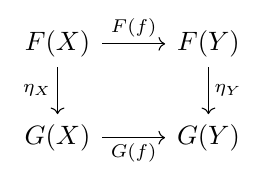
commutes. Equivalently, \(\eta _Y\circ F(f)=G(f)\circ \eta _X\).
The adjective natural means that the component maps do not act as unrelated patches. They transport coherently along every morphism of the source category.
Suppose \(D,D':J\to \mathcal C\) are two realizations of the same learning sketch. A family of local updates \(\eta _j:D(j)\to D'(j)\) is a natural transformation only when it commutes with every realized operation \(D(u)\). Thus an encoder update, predictor update, and decision update cannot be selected independently if the arrows connecting them are to retain their meaning.
This is stronger than the claim that every module improved on its local metric. It is one formal model for a compositional repair. LINCS does not require every repair to be a natural transformation, but when one is claimed, its naturality squares are explicit admission obligations.
11. Objects, functors, and natural transformations form successive levels: components, structured systems, and coherent changes of structured systems. Higher category theory continues this ladder, but the first two levels suffice for most constructions in this book. ↩