lin-0047
2.4 A small factorization example
Suppose a system has an input object \(X\), representation object \(H\), decision object \(Y\), and maps \(h:X\to H\) and \(d:H\to Y\). A declared input transformation \(g:X\to X\) is represented by \(\widetilde g:H\to H\) and \(k:Y\to Y\). The intended square and decision-level equation are
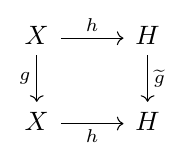
The two route differences can be observed numerically, but the declaration tells us whether the failure belongs to representation transport, decision equivariance, or both. Differentiating the square tells us which local directions change that failure to first order.
If the declared square commutes at \(D\), its tangent lift commutes along admissible tangent directions. Conversely, a nonzero tangent route difference identifies a first-order failure of the lifted declaration, not automatically a parameter update that will repair the base diagram.
Functoriality of the tangent construction preserves the equality of the two composites. The converse claim is deliberately weaker: applying an observation map to the tangent route difference gives a diagnostic direction, while a compositional parameter repair additionally requires an identified map from parameter directions to diagram deformations.
A small infinitesimal obstruction does not establish semantic quality, and a large one does not prove that a supported repair exists. LINCS distinguishes diagnosis, localization, repair, and admission precisely to prevent those inferences.