lin-0063
4.2 Tangent learning sketches
Interpreting a graph in a tangent category is not yet enough. The declared learning constraints must remain meaningful after tangent lift.
A tangent learning sketch is a learning sketch \(\mathbb S=(S,\mathcal D,\mathcal L,\mathcal K)\) equipped with an action of tangent structure on its factorization problems. Whenever \(D:J\to \mathcal C\) is admissible, \(TD\) is admissible and
is the declared tangent factorization problem.
This definition avoids an overly strong claim. The tangent functor need not preserve the quotient \(J/{\sim _{\mathcal D}}\) as a colimit in a category of indexing shapes, nor every cone and cocone appearing in an arbitrary sketch. What is required is a lift on the particular class of factorization problems that the learning system declares.
State tangent admissibility at the level of factorization problems. Do not infer it from the presence of automatic differentiation or from a blanket claim that tangent functors preserve every sketch construction.
One can package this requirement fibrationally. Let
send a factorization witness to its underlying candidate model. Tangent stability asks for a lift \(T_{\mathsf{Fact}}\) making
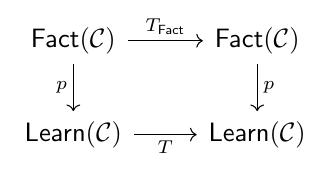
commute, so the fiber over \(D\) is transported to the fiber over \(TD\).