lin-0086
6.4 Why the tangent functor does not supply a Lie bracket
The tangent functor provides tangent objects and their structural maps. It does not, in every tangent category, choose a Lie bracket for arbitrary families of fields. We therefore make the needed enrichment explicit.
A tangent semantic category is bracket-admissible for a class of instances when it carries a bracket operation on the registered vector fields, and when related fields have related brackets. Concretely, if \(V_s,V_t\) and \(W_s,W_t\) are related by \(I(f)\), then \([V_s,W_s]\) and \([V_t,W_t]\) are also related by \(I(f)\).
Smooth manifolds satisfy this familiar related-fields property. Abstract tangent categories require appropriate additional hypotheses or an involution/Lie-algebroid enrichment [ Burke and MacAdam , 2019 ] . The qualification matters: the bracket is an extra operation with laws, not an automatic synonym for tangency.
In bracket-admissible semantics, the componentwise family
is a natural vector field on \(I\).
The registered fields \(V\) and \(W\) are natural, so their components are \(I(f)\)-related for every schema arrow. Bracket admissibility makes their componentwise brackets \(I(f)\)-related. This is exactly the naturality square for \([V,W]\); the section equation follows from the bracket construction on vector fields.
Now choose a visible differential subbundle or distribution
generated by the registered intervention fields. A Lie bracket is an operation on sections, not a fiberwise bilinear map on tangent vectors. Assume therefore that the semantics supplies an object or sheaf of sections \(\Gamma (\mathcal D_{\mathrm{vis}})\) and an object of database vector fields \(\mathfrak X(I)\). The inclusion induces \(\Gamma (j):\Gamma (\mathcal D_{\mathrm{vis}})\to \mathfrak X(I)\), and the bracket of included sections defines
Closure asks whether this operation factors through the visible section object:
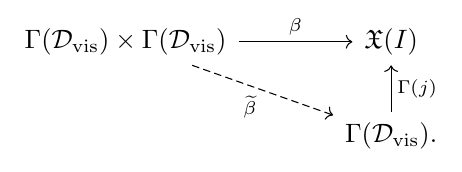
The bracket obstruction \(\mathcal O_{\mathrm{br}}(I,\mathcal D_{\mathrm{vis}})\) is the failure of \(\beta \) to factor through \(\Gamma (j)\). If a normal quotient \(q:\mathfrak X(I)\to \mathcal N\) of section objects is declared, it is observed by
In Riemannian semantics this specializes to the projected normal bracket residual of Chapter 5.
This definition retains the non-scalar character of non-closure. A norm of \(q\beta \) is one observer. The obstruction itself still records the context, field pair, normal type, and route by which closure failed.