lin-0094
7.1 Decision making as universal extension
Let \(\mathcal O\) be a category of observed or locally accessible contexts, \(\mathcal C\) a larger category of contexts in which decisions must be made, and
the functor that relates the two. A local decision model is a functor
where \(\mathcal E\) contains the relevant decision objects: values, distributions, feasible sets, policies, strategies, or enriched utilities.
The pointwise left Kan extension
aggregates the locally available ways of reaching, explaining, or generating a context:
It is the candidate-generating side of decision making: rollout, interpolation, search, accumulation, or forward propagation.
The right Kan extension
assembles what remains compatible with the restrictions, continuations, or tests visible from a context:
It is the coherence side: feasibility, backward consistency, equilibrium, or fixed-point semantics. In the simplest UDL presentation,
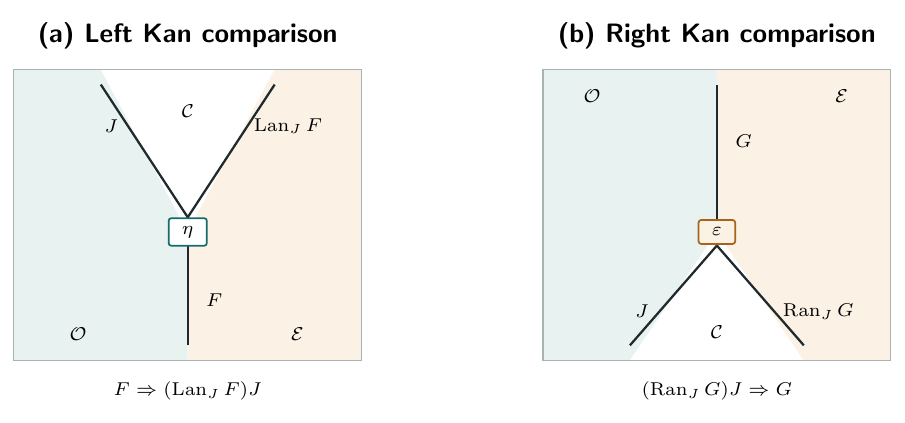
The universal comparisons are especially transparent in the graphical language for 2-categories introduced in Chapter 0. For the right-hand panel below, write \(G=J^\ast L_F\). The left Kan unit changes the direct local wire \(F\) into the composite \((\operatorname {Lan}_JF)J\); the right Kan counit changes the composite \((\operatorname {Ran}_JG)J\) back into \(G\). The two cells face opposite directions, which is the precise graphical content of their left–right duality.

This formula is a semantic pattern, not a claim that every decision algorithm uses the same numerical implementation. The indexing functors, enrichment, order of operations, and approximation scheme are part of the declaration. The universal properties specify what a correct extension must mediate; they do not select data, establish causal meaning, or guarantee that the required limits and colimits exist.
A decision learner must expose both halves of its semantics: how candidates are generated and how global coherence is imposed. A final action can conceal failure in either half.