lin-0268
22.7 Reflective repair and reverse transport
DLINCS requires reverse transport of local obstruction information through shared modules, branches, retrieval systems, and agent graphs. Reverse derivative and reverse tangent categories provide candidate abstractions [ Cockett et al. , 2020 , Cruttwell and Lemay , 2024 ] , but a reverse signal is not yet an admissible forward repair.
Let \(\mathcal B\) be a diagrammatic-backpropagation procedure that maps a global obstruction to local signals and then to parameter or architectural changes. A reflective learning sketch includes \(\mathcal B\), its restriction maps, and its repair maps as arrows. It can then ask whether
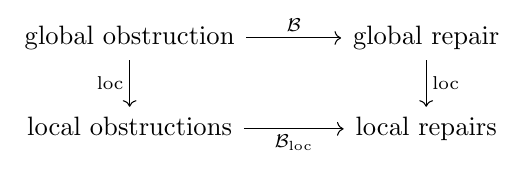
commutes.
Ordinary diagrammatic backpropagation diagnoses a target computation. Reflective LINCS diagnoses how the learning procedure itself transports and repairs that obstruction. A failure may call for a new path, state variable, module, skip connection, memory interface, or compatibility constraint rather than another parameter step.
11. Reflection here is structural, not anthropomorphic: does the repair mechanism compose with localization and restriction in the way its own declaration requires? ↩