sec-graphs-paths-diagrams
0.3 Graphs, paths, and diagrams
A directed graph lists objects and generating arrows but does not yet include all composites. Its path category \(\operatorname {Path}(S)\) freely adds identities and finite paths. This distinction is useful in machine learning: the graph can describe primitive modules, while the path category describes every route that can be built from them.
A diagram of shape \(J\) in a category \(\mathcal C\) is a functor
Informally, \(J\) is the wiring pattern and \(D\) supplies its realization: each formal object receives an object of \(\mathcal C\), and each formal arrow receives a morphism of \(\mathcal C\).
Consider two adapters \(A,B:H\to H\) acting on a hidden-state space. Their two orders form parallel paths
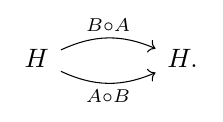
The paths are parallel because they share a source and target. This makes it meaningful to ask whether they agree. ALLORA does not assume that they do: the order discrepancy is part of the structure being diagnosed.
A diagram is commutative when every pair of parallel directed paths with the same endpoints has the same composite. For the square
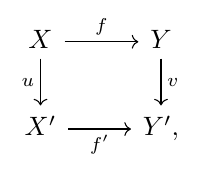
commutativity means \(v\circ f=f'\circ u\).
The square can express equivariance, simulation, consistency under a data transformation, or agreement between direct and transported prediction. Its meaning comes from the labels and chosen category; its categorical form says that two typed routes are intended to agree.
11. A diagram can be meaningful without commuting. In LINCS, a noncommutative diagram is often the observed candidate, while commutativity is the declared structural promise. ↩
Let \(\mathcal V\) be a space of value functions and let \(P^\pi :\mathcal V\to \mathcal V\) be the Markov expectation operator for a policy \(\pi \). With reward function \(R^\pi \), define
A parametrized value family \(\widehat V:\Theta \to \mathcal V\) determines parallel maps
Bellman consistency declares these maps equal. A sampled temporal-difference residual is a numerical observation of their failure to agree at the sampled state and transition.