sec-tangent-structure-language
0.11 Tangent structure and infinitesimal language
LINCS also asks how a compositional failure changes under small, admissible perturbations. On smooth spaces, a tangent vector \(v\in T_xX\) represents a first-order direction at \(x\). A smooth map \(f:X\to Y\) transports it by
The chain rule makes \(T\) functorial. A tangent category abstracts this behavior beyond ordinary smooth manifolds [ Cockett and Cruttwell , 2014b ] .
Let \(a_g:X\to X\) transform an input, let \(F_\theta :X\to Y\) be a learned encoder, and let \(b_g:Y\to Y\) be the corresponding action on its representation. Equivariance is the declaration that the square
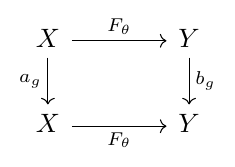
commutes. For an image encoder, \(a_g\) might rotate the image and \(b_g\) might rotate or reindex its feature representation. The sketch records this promise before any norm is chosen to measure its failure.
Applying \(T\) transports the entire declaration:
In ordinary coordinates, its directional part is
The base square asks whether the two routes agree at \(x\). The tangent square asks whether their first-order responses agree around \(x\). A model can therefore fit sampled transformed inputs while remaining locally unstable to nearby perturbations.
An LLM encoder or hidden-state map can occupy the role of \(F_\theta \), but the transformation must be declared carefully. A self-attention block with no positional or causal structure is permutation equivariant; a standard causal LLM with positional information and a causal mask is not equivariant under arbitrary token permutations. Appropriate declarations may instead concern a controlled paraphrase, a formatting transformation, or a simultaneous reindexing of token representations and their structural data. The output action \(b_g\) may be the identity for a decision that should be invariant, or an explicit transport for token-level states. In either case, equivariance is a typed, testable promise, not an automatic property of the language model.
A tangent category packages the chain rule so that LINCS can differentiate a compositional declaration, not merely the individual functions appearing in it.
Two constructions that look similar must be kept distinct. Write
for the fiber power of tangent vectors based at the same point, whereas \(T^nX=T(T(\cdots T(X)))\) denotes iteration of the tangent functor. Thus \(T_2X=TX\times _XTX\) is the domain of fiberwise addition, while \(T^2X\) contains tangent vectors to \(TX\).
A tangent structure on a category \(\mathcal C\) is a tuple
with the following data and axioms.
\(T:\mathcal C\to \mathcal C\) is an endofunctor and \(p:T\Rightarrow 1_{\mathcal C}\) is a natural projection. Every finite fiber power \(T_nX\) of \(p_X:TX\to X\) exists, and every iterate \(T^m\) preserves these pullbacks.
Natural transformations
\[ 0:1_{\mathcal C}\Rightarrow T,\qquad +:T_2\Rightarrow T \]make \(p_X:TX\to X\) a commutative monoid object in the slice \(\mathcal C/X\). Hence only tangent vectors over the same base point may be added.
The vertical lift \(\ell :T\Rightarrow T^2\), together with the zero section, is an additive-bundle morphism from \(p_X:TX\to X\) to \(T(p_X):T^2X\to TX\).
The canonical flip \(c:T^2\Rightarrow T^2\) is an additive-bundle morphism from \(T(p_X):T^2X\to TX\) to \(p_{TX}:T^2X\to TX\).
The lift and flip satisfy the tangent coherence axioms: in particular
\[ c\circ c=1_{T^2},\qquad c\circ \ell =\ell . \]The standard iterated-lift and braid/interchange diagrams involving \(\ell ,c,T(\ell )\), and \(T(c)\) also commute.
Let \(\pi _0,\pi _1:T_2X\rightrightarrows TX\) be the fiber-power projections and define the derived lift
\[ \nu _X= T(+_X)\circ \left\langle \ell _X\circ \pi _0,\, 0_{TX}\circ \pi _1 \right\rangle :T_2X\longrightarrow T^2X. \]The vertical-lift universality axiom requires the square
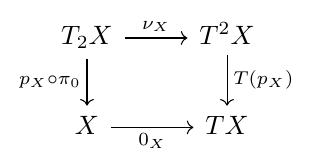
to be a pullback. Equivalently, a second-order tangent that is vertical in the required sense factors uniquely through the derived lift.
A tangent category is a pair \((\mathcal C,\mathbb T)\) of a category and a chosen tangent structure on it.
The last two clauses abbreviate the standard coherence diagrams and universality square of Cockett and Cruttwell [ Cockett and Cruttwell , 2014b , Definition 2.3 ] ; they are axioms, not consequences of the first four pieces of data. In local coordinates on a smooth manifold, the structure has the familiar form
The flip exchanges the two first-order directions in a double tangent, while the vertical lift embeds a tangent vector as a vertical second-order direction.
An endofunctor called \(T\), or the availability of automatic differentiation, does not by itself make a category tangent. The fiber pullbacks, additive bundles, lift, flip, coherence diagrams, and vertical universality property are all part of the declaration. A LINCS application using only some of this structure should state that weaker assumption rather than silently claiming a tangent category.
There is a second boundary that is just as important for DLINCS. The category of finite-dimensional smooth manifolds and smooth maps is a tangent category, but it is not Cartesian closed. It has products, so a smooth family such as a motion of a body can be written
Cartesian closedness would additionally provide an exponential object \(E^T\) and the equivalent curried description
The smooth path space \(E^T\) is generally infinite-dimensional and is not an object of the ordinary category of finite-dimensional manifolds. Thus tangent structure supplies differentiation, but it does not by itself supply internal function spaces [ Lawvere , 1980 ] .
The Kock–Lawvere solution is to embed ordinary smooth spaces into a suitable well-adapted smooth topos \(\mathcal E\) [ Kock , 2006 , Moerdijk and Reyes , 1991 ] . Because a topos is Cartesian closed, it admits the natural correspondence
A parametrized model \(I:P\times X\to Y\) can therefore be treated internally as a map \(\widehat I:P\to Y^X\) into a genuine model-space object. In the same setting an infinitesimal object \(D\) represents tangent structure on the appropriate infinitesimally linear or microlinear objects by \(TX=X^D\). Cartesian closure and tangent structure remain logically distinct requirements; the smooth-topos setting is valuable because it supports them compatibly.
Ordinary smooth manifolds motivate the tangent calculus of LINCS, but the internal higher-order semantics of DLINCS lives in a Cartesian-closed smooth topos. Products support parameterized evaluation; exponentials make spaces of models into objects of the theory.
This passage to a topos changes more than the available collection of smooth spaces. It also gives the theory an internal, generally intuitionistic logic. That logical consequence is the subject of Section 0.12.