lin-0011
The view from above
LINCS begins with a model of the learning system itself. Objects and arrows describe its typed components and legal computations. Equations, cones, cocones, covers, and descent conditions declare the structural promises that those computations should satisfy. A failure of one of these promises produces a typed obstruction. Tangent structure asks how that obstruction changes under admitted local probes; quotienting removes variations that are irrelevant to the declared decision; localization assigns the surviving failure to a cover; repair proposes a typed change; and admission determines whether the maintained system should actually change.
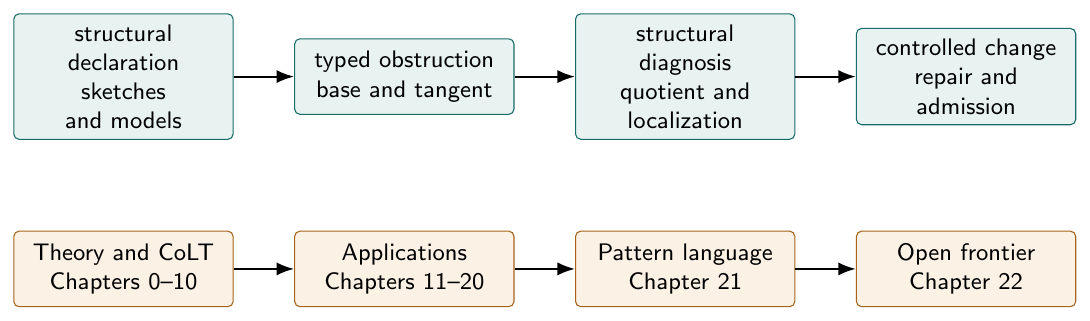
The obstruction is the intellectual hinge. It is not defined by a scalar loss, although scalar observers may measure it. It does not identify its own cause, although localization and domain assumptions may support a diagnosis. It does not authorize its own repair, although its type restricts the repair language. Finally, a successful local repair is not automatically admitted: finite behavior, uncertainty, invariants, and transfer must still be tested.