lin-0025
0.8 Adjunctions and Kan extensions
An adjunction packages a best or universal translation between two categories. Functors \(F:\mathcal C\to \mathcal D\) and \(G:\mathcal D\to \mathcal C\) form an adjunction \(F\dashv G\) when maps \(F(X)\to Y\) correspond naturally to maps \(X\to G(Y)\). The correspondence does not say that \(F\) and \(G\) are inverses. It says that one construction is universally adapted to mapping into or out of the other.
Kan extensions apply this idea to diagrams. Suppose \(K:\mathcal A\to \mathcal B\) changes an indexing shape and \(F:\mathcal A\to \mathcal C\) is known. A left Kan extension \(\operatorname {Lan}_K F:\mathcal B\to \mathcal C\) is the universal way to extend \(F\) along \(K\):
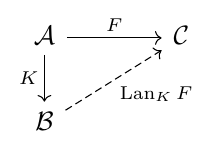
together with a natural comparison
The triangle therefore commutes up to the displayed natural transformation; it is not a strict equality unless additional hypotheses impose one. A right Kan extension is the dual universal construction, equipped with a comparison
In LINCS-KET, direct computation and Kan-extended computation provide two routes. Their discrepancy can be evaluated at the base level and after tangent lift. The Kan extension is not decorative terminology: it specifies which extension counts as canonical relative to the declared change of indexing shape.
Let \(\mathcal A\) index contexts in which a representation has been directly observed, and let \(\mathcal B\) include additional composite contexts. The map \(K:\mathcal A\to \mathcal B\) records the inclusion. A Kan extension constructs values on \(\mathcal B\) from the observed diagram. A separately learned direct route on \(\mathcal B\) can then be compared with this universal extension. LINCS asks whether the two routes agree and how their failure changes under admissible perturbations.