lin-0026
0.9 Sketches: declarations before objectives
A graph says what can be composed. A sketch additionally marks the diagrams that must commute and the cones or cocones that must satisfy universal properties [ Ehresmann , 1968 , Barr and Wells , 1999 ] .
In the notation used throughout this book, a learning sketch is
where \(S\) is a graph of formal operations, \(\mathcal D\) is a family of equations between parallel paths, \(\mathcal L\) is a family of designated limit cones, and \(\mathcal K\) is a family of designated colimit cocones.
When the homs themselves carry essential structure, the same declaration can be made internally to an enriching category. A \(\mathcal V\)-enriched learning sketch consists of a small \(\mathcal V\)-category of generators and composites together with enriched equations and designated weighted limits and colimits. A model in a \(\mathcal V\)-category \(\mathcal C\) is a \(\mathcal V\)-functor into \(\mathcal C\) that preserves the designated weighted constructions. The ordinary definition above is the case \(\mathcal V=\mathsf{Set}\).
The book retains the lighter notation \(\mathbb S\) for both cases and names the enriching base whenever it affects a theorem, obstruction, observer, or repair. This prevents a metric, linear, probabilistic, or order structure used by an implementation from being mistaken for part of every learning sketch.
Let \(J=\operatorname {Path}(S)\). The equations in \(\mathcal D\) generate an equivalence relation on paths that is compatible with composition, and hence a quotient category
A candidate realization is a functor \(D:J\to \mathcal C\). It satisfies the path declarations precisely when it factors through the quotient:
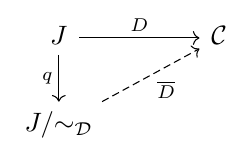
The dashed arrow is therefore a witness of compositionality. For a strict quotient \(q\), such a factorization is unique when it exists.
This factorization is the formal hinge of LINCS. A candidate model need not satisfy it. Diagnosis may reveal a missing path factorization, a missing or nonunique universal filler for a declared cone or cocone, or a witness that is unstable under the declared probes. These distinct failures become structural problems from which obstructions are derived. Only afterward are they observed through vector residuals, norms, likelihoods, hypothesis tests, or decision functionals.
The same four-part declaration takes different meanings later in the book:
in ALLORA, paths are adapter orders and the declaration specifies which compositions should agree or remain safely compatible;
in GIRL, a path equation expresses Bellman consistency;
in RADAR, designated cones encode relational incidence and a shared geometric apex;
in SID, an equalizer cone defines compatible local predictive states;
in LINCS-Toulmin, arrows connect typed claim, ground, warrant, qualifier, rebuttal, and source roles.
The categorical grammar is shared; the semantics and admissible repairs are not.